
Let’s Talk About Decks, from a home inspectors’ point of view, what we look for and what you should be aware of.
Written by Sean Struckmeyer | Tech Inspect Home Services LLC
Nothing says summertime like being out on your deck during the summer! I think we all enjoy time outside on our deck and want it to last for years and years to come. But that requires maintenance and understanding what makes a deck safe.
If you are buying a home with a deck, it will be inspected according to the InterNACHI SOP and there’s an entire sub-section in the inspection report dedicated to decks!
TL;DR – What Home Inspectors Look for on Decks (And Why It Matters)
Of the 45 million decks in North America, only 40% are completely safe. Most collapses happen in summer when decks are occupied. Decks are full structures exposed to weather 24/7 — and they’re inspected that way.
What do inspectors evaluate?
- Ledger board: The connection between the deck and the house is the most critical point. Missing or improperly installed Z-flashing here causes water intrusion and accelerated rot, which can lead to catastrophic failure.
- Posts and beams: 4×4 posts taller than 6 feet require bracing to prevent twisting under load. Posts must bear properly on mounting hardware – gravity alone isn’t enough. Post rot at grade is one of the most common defects found.
- Joists: Must be properly sized and attached to the ledger with joist hangers. Missing hangers mean joists rely solely on nail shear strength to hold weight.
- Guard rails: Posts must be spaced no more than 6 feet apart and cannot be notched. Rails must be 36–42″ tall and baluster spacing must prevent a 4″ sphere from passing through – a child safety standard.
- Stairs: Handrails must be graspable, treads properly spaced, and baluster openings must not pass a 4⅜” sphere.
- Electrical: Any deck 20 sq. ft. or larger accessible from the home requires at least one GFCI outlet.
- Wood-destroying insects: Carpenter bees and termites silently compromise structural members from the inside out.
Hot tub on the deck? A filled hot tub can weigh 4,000+ lbs before anyone gets in. Always consult a structural professional before adding one, never after.
Key warning signs to check yourself: guard rails that wiggle when shaken, soft or spongy wood when probed with a screwdriver, rot at post bases, and missing ledger flashing.
Scary Stats! First let’s get some scary stats out of the way.
Disclaimer
The statistics, observations, commentary, and recommendations presented herein are offered for educational and awareness‐raising purposes only, and do not constitute professional advice, nor are they tailored to any particular property, structure, or jurisdiction. You should not rely upon this information as a substitute for inspection, evaluation, diagnosis, or remedial recommendations by a qualified deck contractor, structural engineer, or other licensed professional. Tech Inspect Home Services and InterNACHI expressly disclaims all liability (including negligence) for any damage, losses, or expenses arising from or associated with the use of, or reliance upon, the information or statements provided. Before undertaking any maintenance, repair, or modification of a deck or related structural component, you are strongly advised to engage a qualified professional to evaluate the particular circumstances, conditions, and local code requirements surrounding decks and like or similar structures (e.g. balconies)
It’s important to note that, over time, the standards used to construct decks have been updated. I’ve shared the following information for you to look over for reference and educational purposes. Any defects found during the inspection will be documented accordingly. For example, deck support requirements have evolved over time, and deck rail connection standards have changed in recent IRC code revisions.
The Following Diagram is provided as a reference for the various structural parts of a deck:
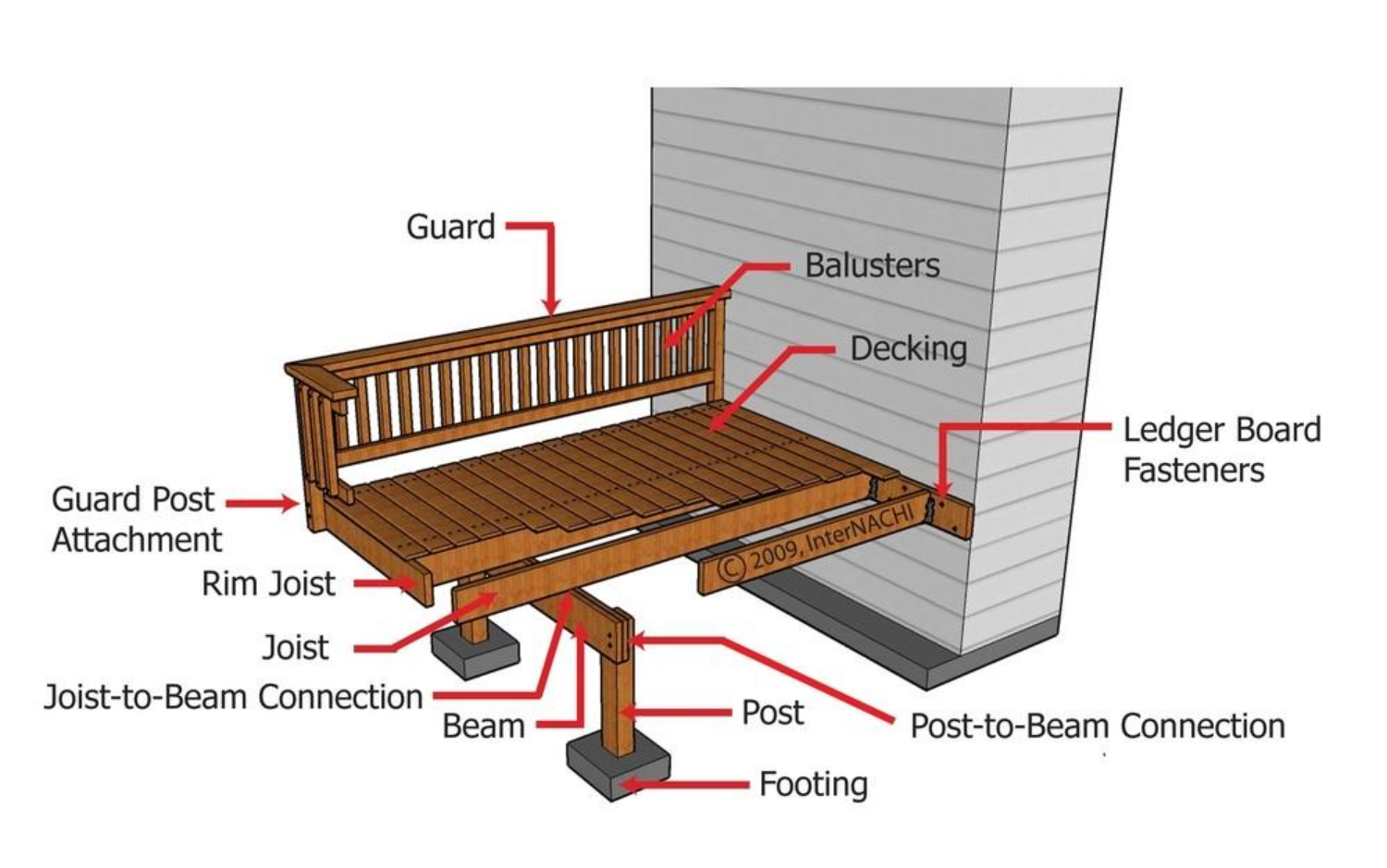
If you have any concerns about a deck, before, during or after an inspection, we strongly recommend a complete evaluation by a deck contractor due to the prevalence of deck failures in the United States. See below for details and homeowner maintenance tips.
Now for the Stats:
According to InterNACHI, More than 2 million decks are built and replaced each year in North America. InterNACHI estimates that of the 45 million existing decks, only 40% are completely safe. Because decks appear to be simple to build, many people do not realize that decks are, in fact, structures that need to be designed to resist certain stresses adequately. Like any other house or building, a deck must be designed to support the weight of people, snow loads, and objects. A deck must be able to resist lateral and uplift loads that can act on the deck as a result of wind or seismic activity. Deck stairs must be safe and handrails graspable. And, finally, deck rails should be safe for children by having proper infill spacing. A deck failure is any failure of a deck that could lead to injury, including rail failure, or total deck collapse.
There is no international system that tracks deck failures, and each is treated as an isolated event, rather than a systemic problem. Very few municipalities conduct investigations into the cause of the failure, and the media are generally more concerned with injuries than with the causes of collapses. Rail failure occurs much more frequently than total deck collapses; however, because rail failures are less dramatic than total collapses and normally don’t result in death, injuries from rail failures are rarely reported.
Here are a couple of noteworthy facts about deck failure:
- More decks collapse in the summer than during the rest of the year.
- Almost every deck collapse occurred while the decks were occupied or under a heavy snow load.
So what do we look for during an inspection? Short answer is, A LOT.
The following are examples of items that a home inspector looks for during an inspection with provided real-world examples of issues found. The key concept we wish for homeowners to understand, is that decks are entire structures unto themselves, just like a home, and they are exposed to the weather 24x7x365. Therefore, if they are not built and maintained correctly, then there will be issues and potential safety concerns that impact the usability and enjoyment of the deck.
1) The overall condition of the deck, specifically any worn or deteriorated lumber, warped or rotting boards
- This includes deck boards, joists, ledgers, posts, beams and rim joists. Remember, even pressure treated wood doesn’t last forever.
- How close to grade is the treated or untreated lumber? There are minimum standards for this as well.
- Non-treated wood should have a minimum clearance of 18″ and treated wood should have a minimum clearance of 12″. This is to prevent premature wood decay.
- Overall how was the deck built?
- Are the beam spans and spacing appropriate?
- Is there adequate bracing and blocking throughout the deck?
- Overall Deck Height, to ensure guard-rails and stair stringers are appropriate.
- Are the deck boards properly supported?
- Are the deck boards staggered and off-set?
- If the butt joints are not staggered, then they can create stress points and a ‘weak link’ that runs across the deck.
- Are the deck boards properly secured?
- Are the deck boards properly spaced from each other?
- Deck boards should be installed with a minimum 1/8″ gap. When deck boards are installed too close together, they trap moisture, prevent drainage and air circulation, and don’t allow for natural expansion and contraction. That leads to warping, buckling, cupping, rot, fastener failure,
- Is the deck cantilevered, is it supported properly?
2) Ledger Board Attachment
- Condition of the ledger board
- Overall Installation of the ledger board, is there z flashing installed on-top of the ledger board to prevent water from getting between the board and the house leading to pre-mature rot and ultimately failure of the ledger board?
- Is the Z flashing properly caulked
- How is the ledger board attached to the home? Is it properly mounted?
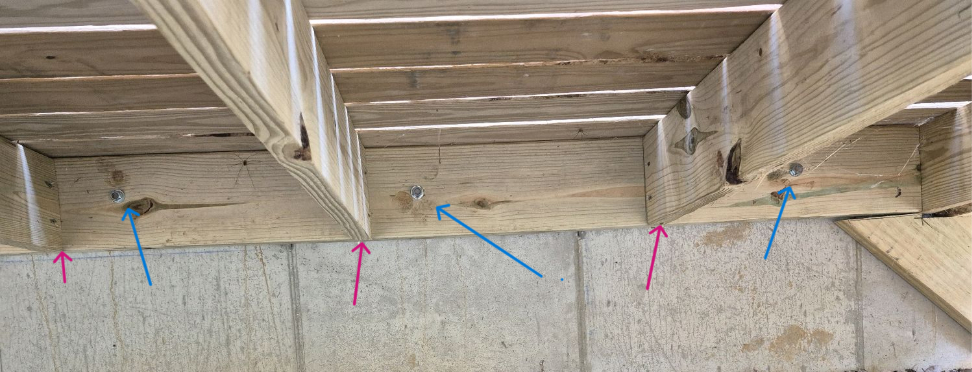
Here is an example of a properly secured ledger board, using red-head anchor bolts into concrete. However, in the same picture a defect exists, in that there should be joist hangers installed or a furring strip for the joists to sit on at the ledger board. So while the ledger board was attached to the home correctly, the joists were not attached to the ledger board correctly. In that there was no mechanism installed to help hold the weight of the joists beyond the sheer strength of the nails or screws.
3) Deck Joists
- Are the joists of an appropriate size, meaning 2×10, 2×12’s?
- Are the joists supported and attached to the ledger board with joist hangers? (see above picture for an example of missing hangers)
- Do the joist hangers have all the right nails or structural screws?
- Are the joists damaged?
4) Deck Posts
-
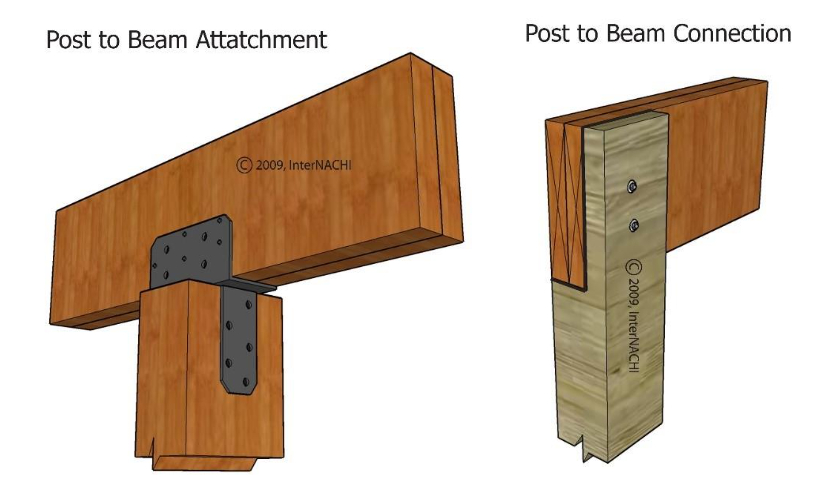
- Deck posts must bear on top of another post, either directly on top or on a notched post with a minimum of 2” of wood remaining. This means you can notch a 4×4 post and rest a single 2x on it, but there’s no room for error on notching out the post.
Example diagrams of a correct post to beam attachment:
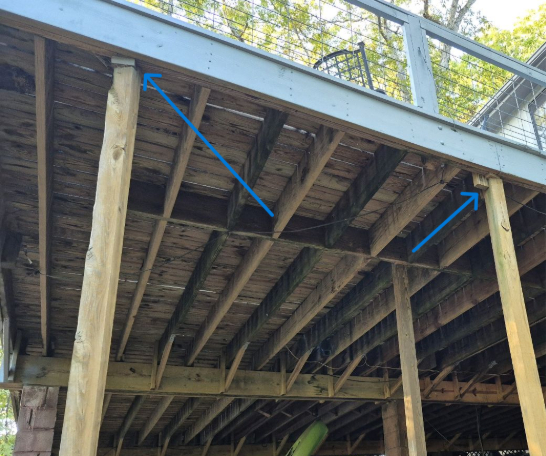
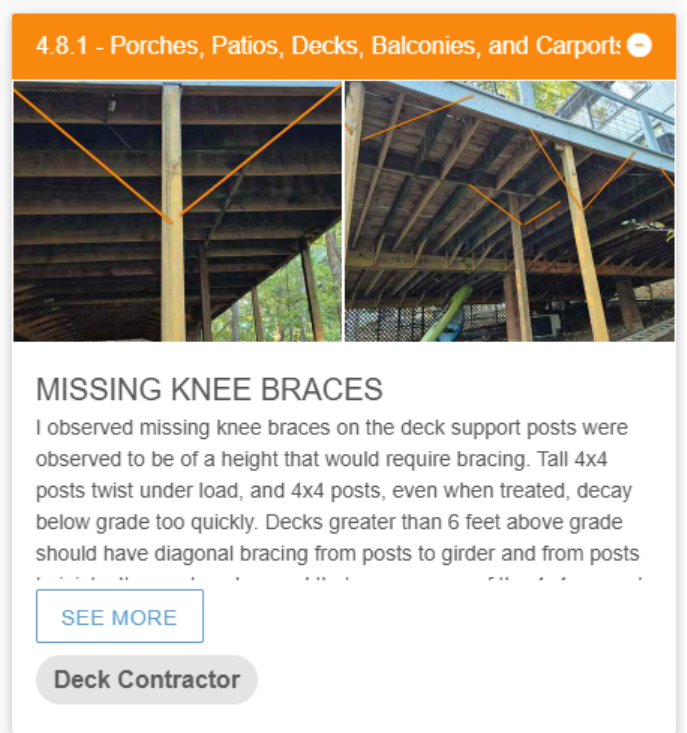
- Post Height, Post Size, and post bracing, as a general rule deck posts should be built with 6×6 posts and not 4×4 unless it is a lower deck, <6 ft. According to the building standards, a 4×4 may be used up to 14 feet in height. However, extra bracing is required to support the post and prevent it from twisting.
Here is an example of 4×4 posts that were approx. 9-10 feet height and had twisted under the load and sample form the inspection report, noting the missing knee braces.
- Are the posts properly secured to any mounting brackets? Mounting brackets usually require nails or certain structural screws to secure them. We won’t want to rely on gravity alone.
- Such as in this example where all the mounting plate holes were left unfilled, and only gravity was holding the deck post to the mounting plate.
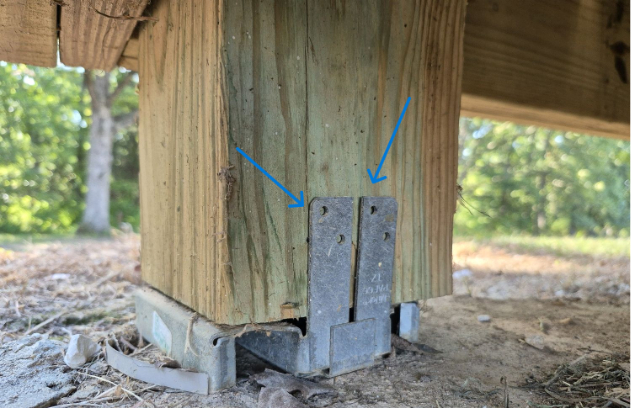
- Such as in this example where all the mounting plate holes were left unfilled, and only gravity was holding the deck post to the mounting plate.
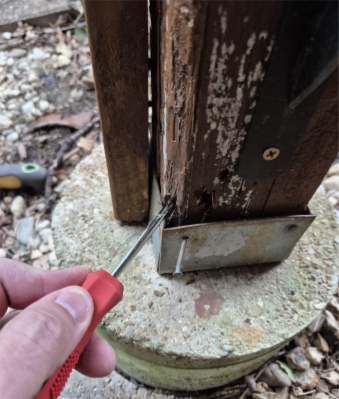
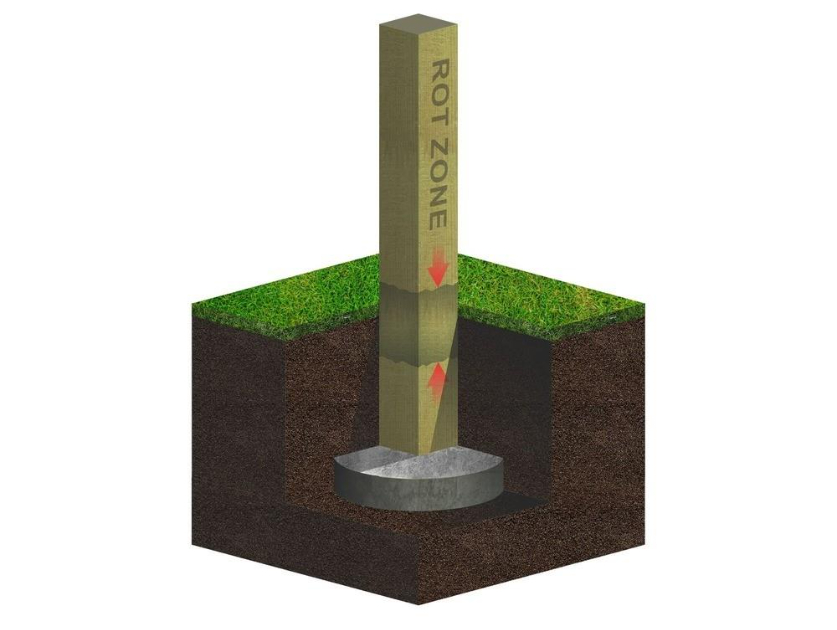
- Post Rot, We also look for post rot at grade and review any of the exposed concrete used to set the post for damage.
- A significant contributor to post rot is poor water management, if gutters are discharging near the post and splashing it, or run-off is pooling around the posts, this will cause them to rot out quicker, resulting in an accelerated replacement cycle.
- Deck posts must bear on top of another post, either directly on top or on a notched post with a minimum of 2” of wood remaining. This means you can notch a 4×4 post and rest a single 2x on it, but there’s no room for error on notching out the post.
5) Guard Rails, there are numerous factors we inspect when reviewing guard rails.
-
- Guard Rail Post should be no more than 6 feet on center. Any span larger than that and the railing may not be strong enough to withstand 200 lbs of force (per square foot) applied to it. What this means is if a 200lb man were to lean against it or fall into it, it may not be strong enough to hold the weight, collapse resulting in a fall and injury.
- Guard Posts may NOT be notched. This has been common practice in previous years, but is no longer allowed. Now guard posts, must not be notched, and secured bolted to the rim joist.
Example diagram of a rail post properly attached to the rim joist.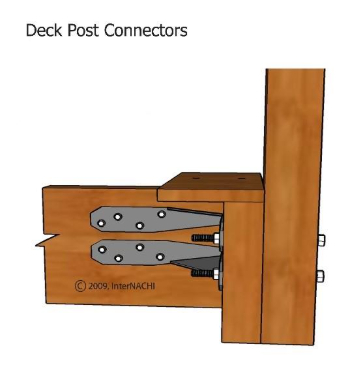
- Guard Rails must be between 36” and 42” above the decks surface
- Are the guard rail posts loose?
- Are the guard rail posts cut to allow water to run off?
- Rail Balusters, must not allow a 4” sphere to pass through them. This is a child safety standard.
6) Stairs and Stair Rails have a set of standards that must be followed
- Hand Rails must be graspable and at the appropriate height
- Stair guards openings between the balusters must not allow passage of a 4 3/8” sphere (child safety again)
- Stair guard openings at the bottom and the treads must not allow passage of a 6” sphere (child safety)
- Are the stairs lighted?
- Are the hand rails loose?
- Are the stair treads deep enough?
- Are the stair treads spaced correctly, height wise?
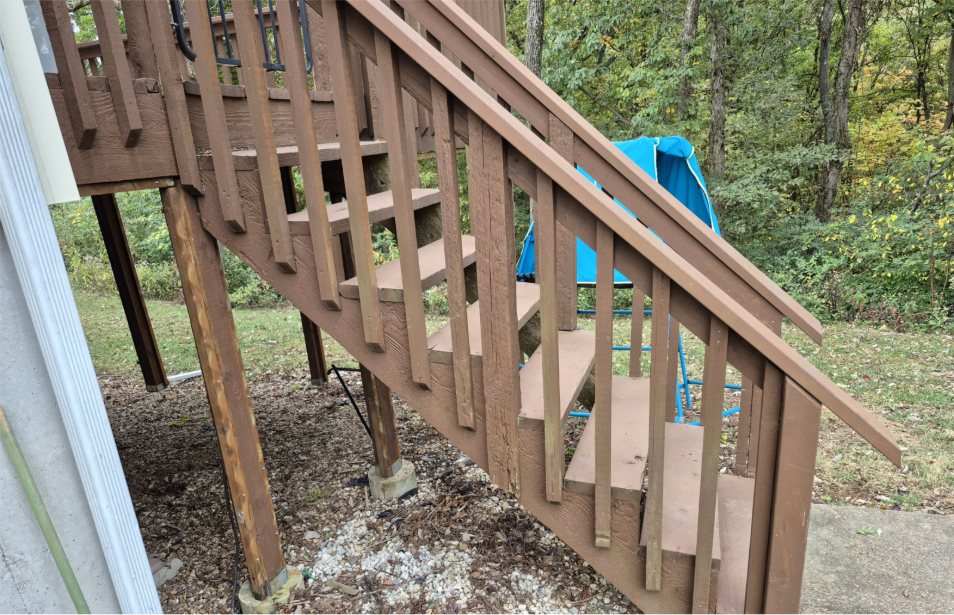
- Are the stairs set an appropriate pitch? Steep stairs are difficult to go up and down. The following picture is an example of stairs that were very steep and difficult to walk down, which also had loose railing and rotten support posts.
7) Electrical Service Requirements, Yes, even decks require outlets per building standard and code!
- All exterior/outdoor outlets must be GFCI, even if they are in a waterproof box, the outlet itself must be a Ground Fault Circuit Interrupter.
- Per the 2009 IRC, any deck accessible from within the home that is 20sq ft or greater in usable area must have at least one receptacle within the perimeter of the deck or balcony that is not greater than 6 feet 6″ above grade. Meaning the receptacle must not be installed a height of 6 feet 6 inches so that a person can actually reach it and use it.
8) Wood Destroying Insects
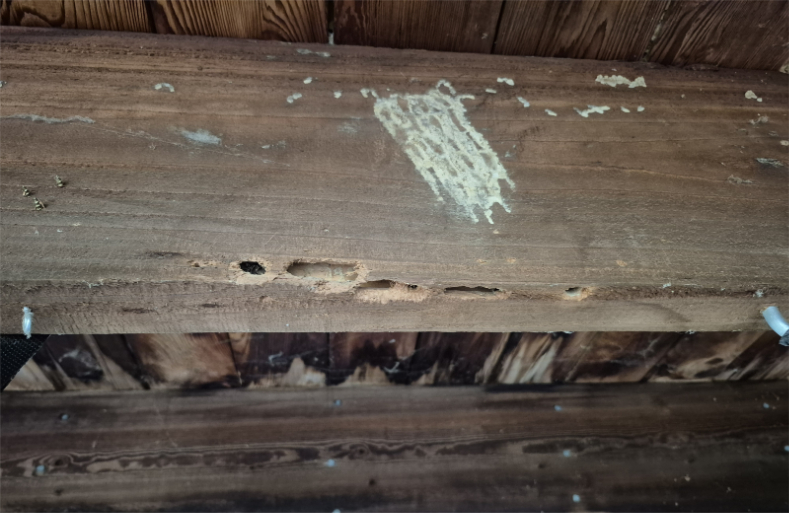
- Wood destroying insects or organism (WDO) like carpenter bee’s and termites can wreak havoc on a deck, weakening the wood and ultimately the support the boards are supplying. Paying attention to damage early and getting ahead of it, can prevent larger issues later.
Example of a Deck Joist Damaged by Insects.
Safety Tips for Homeowners:
- Regularly inspect your deck for loose screws, boards etc.
- You can check your railing to see if it’s beginning to loosen up, just by trying to shake it. If it wiggles and moves, it’s probably time to consult a professional.
- Be conservative about loads: don’t put heavy loads like hot tubs, large planters, or concrete pavers unless you know your deck is designed for them. Consider consulting a structural professional if you plan to change the use.
Hot Tubs and Decks:
- Be aware of weight and how much weight a deck can hold. Specifically, if you are thinking of putting a hot tub on a deck, you need to first consult with a professional deck builder to determine if the deck can actually hold the weight or be retrofitted to hold the weight. You need to do this BEFORE you visit the hot tub store. You need to have them analyze the dead and live loads that the deck is able to handle.
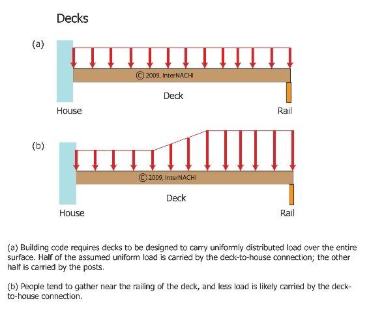
- Water weighs 8.3 lbs. per gallon, most hot tubs hold 450-500 gallons of water, so that can easily add 3,700 – 4500 pounds of weight, just in the water and hot tub shell, in a small area (most hot tubs are only 7 feet by 7 feet). That’s 4,000 lbs. BEFORE anyone gets into it.
- If your deck is not designed and built to handle that much weight in a small area, the chances of the deck collapsing are extremely high!
- If in doubt, consult with a professional and have the deck assessed for how you are planning to use it.
- Note: Even the Coleman inflatable hot tubs hold 177 gallons or ~1,500 pounds, before anyone gets into it. Are you sure, your deck can hold that?
Deck Maintenance Tips:
- Once a year (or more in harsh climates) probe critical wood members with a screwdriver or probe tool to detect softness, sponginess, or flaking.
- Pay particular attention to where wood meets wood or wood meets soil, and on the ledger board flashing. If flashing is failing, water gets behind the ledger, and rot accelerates.
- Replace compromised wood immediately. Don’t patch rotten members. If a post is rotted at the base, the entire post is compromised and must be replaced.
- Check that all screws, nails, bolts, hangers are tight and intact at least once a year. If you see rust or corrosion, replace with corrosion‐resistant hardware (stainless, hot-dip galvanized, etc.).
- Ensure the ledger is properly flashed and fastened (lag screws or bolts, full-bearing) and that the connection meets code. If there’s any sign it’s pulling away, that’s a red alert, and you need to consult with a deck contractor immediately.
- In beam‐to‐post connections, make sure the hardware (post caps, straps, notches) is correctly installed and maintained.
- Sweep off the deck often; remove leaves, debris, and anything that holds water. Also, clear out stuff between boards.
- Clean the deck (top and underside) with appropriate cleaners, especially before resealing or staining; avoid letting mold or mildew go unchecked.
- Make sure there’s proper drainage under the deck, posts have space (airflow) at the bottom, and no direct soil contact wherever possible. Add gravel, use concrete piers, post bases with standoffs if needed.
- Test seal regularly (e.g. water‐drop test: if water soaks in instead of beading up, time to reseal).
- Apply or reapply a quality sealant or stain per manufacturer’s recommendation (often every 1-3 years depending on exposure).
- Use coatings with UV protection if deck is exposed to sun.
Example of where posts are most susceptible to rot:
In Summary: Keep Your Deck Safe: What Every Homeowner Should Know
Of the 45 million decks in North America, only 40% are completely safe. Most deck collapses occur during summer when they’re occupied, and many failures could be prevented with proper inspection and maintenance. As home inspectors, we evaluate critical components including ledger board attachments, post conditions, structural support systems, and safety features like guard rails and stairs. Common issues we find include rotted posts at grade level, improperly secured ledger boards, inadequate bracing, and guard rails that don’t meet safety standards.
Don’t wait for a problem to become a disaster. Regular maintenance and professional inspection can identify hidden dangers before they lead to injury or collapse. Whether you’re buying a home with an existing deck or concerned about your current one, a comprehensive inspection following InterNACHI standards will give you peace of mind and keep your family safe.
Key Warning Signs:
- Guard rails that wiggle or move when shaken
- Soft, spongy wood when probed with a screwdriver
- Posts showing rot at ground level
- Missing or damaged ledger board flashing
- Delayed Maintenance, warped boards
📋 Schedule Your Professional Home Inspection Today Contact Tech Inspect Home Services for a comprehensive deck evaluation. Protect your investment and your family’s safety with an expert inspection.