
Questions to Ask Your Home Inspector During the Walkthrough and After the Report

The inspection itself is only half of what you're paying for. The other half is the conversation, the walkthrough at the end, and the follow-up after you've read the report. That's when a good inspector turns a long list of findings into what actually matters for your decision, on your 10-to-15-day clock.
Most buyers walk into that conversation without a plan and walk out with vague reassurance instead of answers. This guide helps with that. Here are the questions worth asking, and one common question a home inspection genuinely can't answer, so you know exactly where to take it instead.
One note on timing before we dive in: the best moment for these questions is the walkthrough at the end of the inspection, and then again after you've read the full report, not while the inspector is still working through the home. Let the inspector do the job uninterrupted, then use the read-out to ask everything on your list. You'll get better answers and a more thorough inspection.
The most useful questions to ask a home inspector are: Where are the main water, gas, and electric shutoffs? How old are the roof, HVAC, and water heater, and when should I budget to replace them? Did you see any signs of past or present water intrusion? What did you find in the attic and crawlspace, and were they fully accessible? And which specialists or additional tests do you recommend? Note that a standard home inspection does not verify building permits; permit history is publicly available through your local municipality, not from the inspector.
Where are the main shutoffs: water, gas, and electric?
In an emergency, a burst supply line, the smell of gas, knowing where to cut the water, gas, or power is the difference between a quick save and a flooded basement. It's a fair question at the walkthrough, and it's one we answer in writing: every Tech Inspect report documents the location of the main shutoffs, so you're not hunting for them months later at 2 a.m. Ask us to point them out in person during the walkthrough.
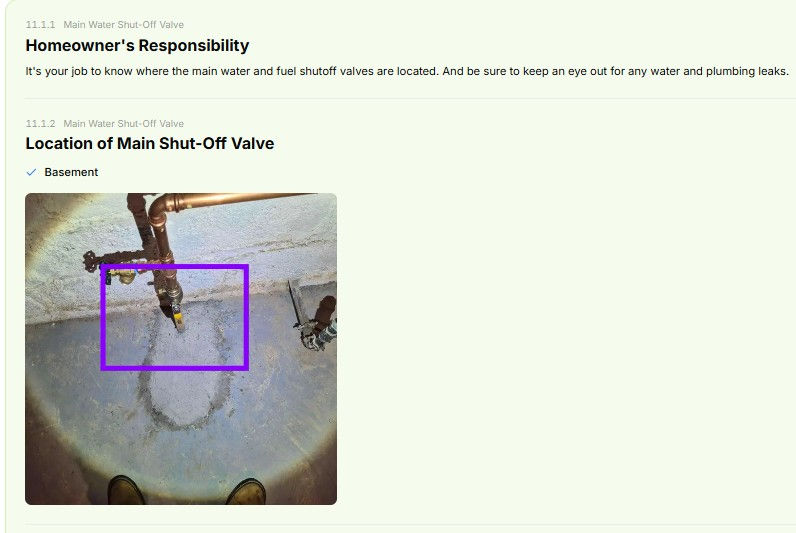
One thing we don't do, and no inspector should: turn valves. We locate and document the main water, gas, and service shutoffs, but we don't operate them; an old valve can fail or leak when forced. Finding and documenting them is our job; operating them is left to you or the appropriate utility.
How old are the roof, HVAC, and water heater, and when should I budget to replace them?
This is the question everyone wants a single number for: how many years do I have left? No one can reliably predict the remaining life of a roof or a mechanical system, and an inspector who hands you a confident countdown is guessing. What we can give you are the two things that actually help you plan: each system's age, where it can be determined, and how that compares to typical service life.
Roof. In line with industry Standards of Practice, we don't estimate the remaining service life of a roof covering. Too many variables affect it: hail, high winds, factory defects, installation quality, and we weren't there when it went on. What we do provide is context. Ask the current owner when the roof was installed; if you can pin that down, you can place it in its lifecycle. As a general guide, architectural composition shingles typically last about 21–24 years and 3-tab asphalt shingles about 12–18. Knowing a roof sits in, say, the last third of that range tells you to start planning. We always recommend a roofing contractor review the roof for a detailed condition assessment.
HVAC. We read the age off the condenser's data plate, for example, serial and model coding that places a unit at nine years old, and compare it to the typical 10-to-15-year service life for a central AC condenser or heat pump. Once a unit passes the 10-year mark, it's smart to start setting aside replacement funds. Annual professional maintenance is the single best thing you can do to get the most life out of it.
Water heater. Same principle: we document its age so you can plan ahead instead of getting surprised. Ask how that age stacks up against typical service life, and fold a future replacement into your longer-term budget.
The things to know across all three are the same: age and context, not a countdown clock. An honest "here's how to plan for it" beats a made-up number every time.
And you don't have to keep those numbers in your head. Our free home maintenance planning spreadsheet, on the resources and downloads page, is built for exactly this: log the age of the roof, HVAC, water heater, and other big-ticket systems, line them up against typical lifespans, and set money aside before a replacement turns into an emergency. It's the same planner attached to every Tech Inspect report, free to download and start using today, whether you're buying now or maintaining the home you already own.
Did you see any signs of past or present water intrusion?
Water is the most expensive problem in most homes, and usually the quietest. Ask specifically: did you see evidence of water getting where it shouldn't, in the basement, the crawlspace, around windows, at the roof penetrations? And just as important, does it look active or historical? A dry stain from a repair made ten years ago is a very different conversation than a damp foundation wall today. Ask what conditions around the home invite water, such as grading that slopes toward the foundation or downspouts dumping right at the wall, because those are fixable and worth addressing early.
What did you find in the attic and crawlspace — and were they fully accessible?
Some of the most important findings live in the spaces you'll never look at yourself. Ask what we saw up top and underneath: ventilation, insulation, moisture, framing, and, just as important, whether those areas were fully accessible. A crawlspace blocked by stored belongings or an attic with a tight scuttle means part of the home couldn't be fully evaluated, and you'll want to know exactly what was and wasn't reachable. If attic ventilation or moisture comes up, ask us to walk you through what we saw and why it matters; it's one of the most common places hidden problems start.
Can you confirm whether the previous work was permitted?
This one comes up constantly, and it's worth being straight about: a home inspection does not verify permits. We don't confirm whether that finished basement, added deck, or extra bathroom was permitted, inspected, or closed out. Open, closed, or historical permits are simply outside the scope of a home inspection, and it wouldn't be honest to imply otherwise.
The good news is the information is public. Permit history is held by the local building or code-enforcement office for the city or county the home sits in, you or your agent can request it directly from that municipality. If we see work that looks amateur or not built to standard, we'll absolutely flag the workmanship. We just won't tell you it was or wasn't permitted, because that isn't something a home inspection checks.
Which specialists or additional tests do you recommend?
A general home inspection is broad by design, and it's also the map that tells you where to look closer. Always ask what we'd recommend evaluating further, and as a rule, we recommend having any system or component with a noted defect reviewed by a qualified specialist during your due-diligence window, while you still have time to act. Depending on the home, that short list often includes:
Sewer scope: a camera run of the sewer lateral, especially on older homes or lots with large trees, where root intrusion and pipe damage hide underground.
Radon test: a 48-to-72-hour measurement of a colorless, odorless gas; worth considering on nearly any home, particularly with basement or ground-level living space.
Mold air sampling: when there's visible suspected growth or a musty odor, lab-based sampling is a separate service that confirms what a visual inspection can only note.
Well and septic testing: on rural and acreage properties, private wells and septic systems each need their own dedicated evaluation to confirm they're healthy and meet local health-department requirements.
WDO/termite inspection: the formal "termite letter" is issued by a separately licensed WDO inspector. We flag visible signs during the inspection and refer you to the right professional for the report your lender or contract may require.
The pattern holds every time: the inspection finds the questions, and the right specialist, brought in on time, gets you the answers before your window closes.
See exactly how we document what we find
The clearest way to understand how these answers show up in writing is to open a real report. We've published three full sample reports you can click through just like a client would, with the photos, video, plain-English findings, and yes, the documented shutoff locations, all in place. It takes about two minutes, and it's the best picture of what you'll walk away with.
When you're ready, see everything inside a Tech Inspect report or schedule your inspection, same-week availability, weekend appointments, and a report delivered within 24 hours.
Frequently asked questions
What questions should I ask a home inspector? Ask where the main water, gas, and electric shutoffs are; how old the roof, HVAC, and water heater are and when to budget for replacement; whether there are signs of past or present water intrusion; what was found in the attic and crawlspace and whether those spaces were fully accessible; and which specialists or additional tests are recommended for your specific home.
When is the best time to ask the inspector questions? At the walkthrough at the end of the inspection, and again after you've read the full report. Let the inspector work through the home uninterrupted first, you'll get a more thorough inspection and better answers during the read-out.
Do home inspectors check for permits? No. A standard home inspection does not verify building permits, whether open, closed, or historical. Permit history is public and available from the local building or code-enforcement office for the city or county where the home is located; you or your agent can request it there.
Can a home inspector tell me how many years my roof or HVAC has left? No. The remaining service life can't be reliably predicted, and industry Standards of Practice don't estimate it for roof coverings. An inspector can document a system's age and compare it to typical service life so you can plan for replacement, but any specific "years left" figure is a guess.
How can I plan for big repairs like a new roof, HVAC, or water heater? Log the age of each major system, compare it to its typical service life, and set money aside before replacement is due. Tech Inspect offers a free home maintenance planning spreadsheet on its resources and downloads page to help homeowners track system ages and budget for these replacements over time; the same planner is attached to every inspection report.
Will the inspector turn on the water or gas shutoffs? No. Inspectors locate and document the main shutoffs but don't operate them, because an old valve can fail or leak when forced. Operating a shutoff is left to the homeowner or the appropriate utility.
Which additional inspections should a buyer consider? Common add-ons include a sewer scope, a radon test, mold air sampling if growth is suspected, and dedicated well and septic testing on rural or acreage properties. Any component with a noted defect should be reviewed by a qualified specialist during the due-diligence period.
Ready to get real answers, not vague reassurance?
Same-week availability, weekend appointments, and a report delivered within 24 hours, with the shutoffs, system ages, and findings documented in plain English. See three full sample reports, explore everything inside the report, or schedule your inspection.
Tech Inspect Home Services LLC · 3580 Highway T, Marthasville, MO 63357 · 636-201-6366 · sean@techinspecthome.com

