
Before Your Home Inspection, Decide What Would Make You Walk Away

As a home inspector, some of the best advice I can give home buyers is to consider what your deal breakers are before I do the inspection, make a list, and have it ready.
In this post, the goal is to provide home buyers with some earnest guidance, as this is a common question that's asked after the inspection. Most people have the inspection and then ask, do I walk? Is this bad? How bad is this? I try really hard to put things into context within the report (using tags, defect labels, and more) and during the debrief, but if you don't have anything to compare it against, some of the context does get lost.
Once you're under contract, you're on a short timeline, usually 10 to 15 days to inspect, gather quotes, and negotiate. That's not much time, but it does give you an opportunity to do some thinking and planning. Decide, in writing, what you're willing to take on and what you're not, before the findings can cloud the decision. Especially if this is your first home: our complete first-time buyer's guide to home inspections walks through the whole process, and this post zooms in on one decision you should make before any of it. Once you have the list, discuss with your agent, get their input, leverage their expertise, and ensure you are all on the same page as to what your non-negotiables are.
Before your home inspection, decide what would make you walk away from the home. The problems most likely to end a deal are major structural defects, safety hazards, chronic water intrusion, environmental issues like mold or radon, and repair costs beyond your budget, but the line is different for every buyer. Write down your non-negotiables in advance, based on your budget, timeline, and risk tolerance, then use the inspection report as a decision tool instead of reacting to it under pressure.
Why decide your deal breakers before the inspection?
Two reasons: time and objectivity.
A home inspection is a risk-management tool. Buying a home is one of the largest financial transactions most people ever make; it's roughly the equivalent of buying ten to fifteen cars at once, on a loan you'll carry for decades. The inspection exists to hand you an unbiased picture of what you're actually buying, so you can weigh it against your budget, your timeline, and your risk tolerance. We dug into that mindset in Home Inspections: The Ultimate Risk Management Tool for Buyers and Sellers.
But here's the piece people might overlook. The inspection identifies the risks. You decide which ones you're willing to carry. And that second part is far easier when you've defined your limits in advance instead of reacting to them under pressure. Walk in knowing your line, and the report becomes a checklist against a plan. Walk in without one, and every finding feels equally alarming while the clock ticks.
What kinds of problems make a house worth walking away from?
I expect that every buyer's list is different, and it should be. What one buyer shrugs off, another can't live with. Your budget, your goals, your timeline, and your risk tolerance all move the line. So treat what follows as categories to think through, not a set of rules.
That said, the issues most likely to end a deal tend to fall into a few buckets:
Structural. Foundation cracking or movement, ongoing settlement, sagging rooflines, rotted framing. These point to expensive, long-horizon repairs, and they're the fastest way a home's condition can scare off both buyers and lenders.
Safety. An unsafe electrical panel, an active gas leak, a backdrafting appliance, missing handrails, a deck that isn't safe to stand on. Some are cheap fixes and some aren't; a $9 door hinge and a full panel replacement are both "safety issues." What matters is whether you're willing to own the risk until it's corrected.
Water. This is the one we harp on. Active leaks, chronic moisture, a basement that's been losing a fight with groundwater for years. Water damages a home quietly and quickly, and it's usually the root of the bigger problems down the line.
Environmental. Mold, elevated radon, asbestos, or lead paint, more common in older homes, and worth a hard look if you're buying one. If you are, these seven items are worth checking.
Cost beyond your budget. Sometimes nothing is unsafe. The repair cost is just higher than the budget you have. Buying at the top of your budget already carries more risk, because a home with real issues can tip a stretched payment from a blessing into a burden.
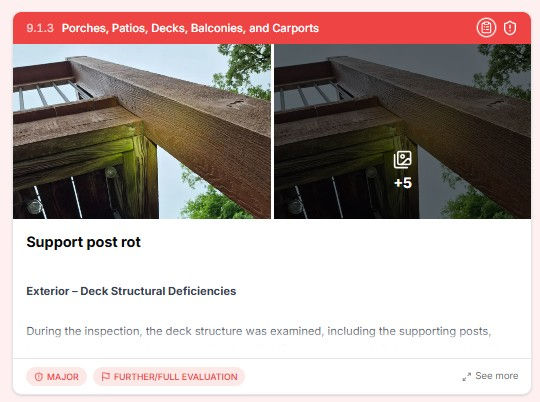
Photo: a red-carded "Major Concern" defect from an inspection report of an unsafe deck
There's one more that catches buyers off guard: some conditions can make a home hard to insure or finance. If you're using an FHA or USDA loan, certain safety and structural defects can slow the loan down or stop it entirely, so those items may be non-negotiable whether you want them to be or not.
How do you actually set your non-negotiables?
Get specific before the inspection and write it down. In order to get specific you need to define the system, for example the Roof, HVAC ( you can break this down by A/C or Furnace), Electrical Panel, Sewer Lateral, Foundation. Then decide what your non-negotiable on that is, is it price alone or something more?
Let's use HVAC for example to write this out:
Our non-negotiable for an HVAC system needs to be replaced, and the cost is greater than $12,000; it's beyond our budget and is a non-negotiable.
In the above statement, we've identified the system, the condition (it needs to be replaced), and our budget threshold. Meaning if we can get a new system for less than $12k, we might continue with the home.
We recommend going system by system and putting a rough line on each of the big parts of the home.
Another classic example is the roof: if this home needed a full roof, is that within budget? Is there room to negotiate the price? If the answer is no, then you already know what a bad roof means for you, before you're staring at the photos. Do the same for the foundation, the HVAC, and the electrical panel.
On a rural or acreage property, add the well and the septic. Those are systems a lot of buyers have never dealt with, and a failing one might be a hard stop or just a negotiation point. When we had our well pump replaced, it was $4k, a new well starts at $20k, and a new septic system will easily be over $20k.
Then share the list with your agent. Between the two of you, you'll have a framework to hold the report up against instead of reacting to it cold.
What if the inspection turns up one of your deal breakers?
First, breathe. And remember this: it isn't the inspection that killed the deal. The condition was already in the house, the inspector just found it and put it on paper. You're better off knowing than finding out the hard way.
Then treat your contingency window like a short project with a tight deadline. Pull the recommended contractors from the report, get quotes, and gather real numbers. Everything can be fixed; the only questions are how long and how much. Once you have the information, you decide: negotiate repairs, ask for a credit, or walk. If you need help thinking through the findings, that's exactly what we're here for — we cover the "now what" in this post, and our Resources & Downloads page has a free repair planner that lines up with the report.
And if you do walk away, that's not a defeat. Everything in a house can be fixed — that doesn't mean you have to be the one to fix it. There's always another house.
In Summary:
An inspection tells you what you're buying. Your non-negotiables tell you whether you should. Decide them early, hold the report up against them, and let the facts drive the call — not the pressure of the clock or the pull of a home you've already fallen for. We should own our homes, not let our homes own us.
See exactly what a report gives you to decide with
The clearest way to understand what you'll be weighing is to open a real one. We've published three full sample reports you can click through just like a client would — with the color-coded findings, photos, video, and plain-English narratives in place. It takes about two minutes.
When you're ready, schedule your inspection — same-week availability, weekend appointments, and a report delivered within 24 hours, so you have time to review, get quotes, and negotiate inside your window.
Frequently asked questions
Should I decide what would make me walk away before the home inspection? Yes. Deciding your dealbreakers in advance — based on your budget, timeline, and risk tolerance — lets you read the report as a decision tool instead of reacting under the pressure of a short contingency window. Write down a rough limit for each major system before the inspector arrives.
What are the most common home inspection dealbreakers? The issues most likely to end a deal are major structural defects (foundation, framing, settlement), safety hazards (electrical, gas leaks, missing handrails), chronic water intrusion, environmental issues like mold or radon, and repair costs that exceed your budget. What counts as a dealbreaker still depends on the individual buyer.
Can I back out of a home purchase after the inspection? Usually, yes — if your contract includes an inspection contingency. The exact rights and the way written notice must be delivered vary by contract, so read the terms and confirm the process with your real estate agent before you sign.
Does finding a major problem mean the deal is dead? No. A home can't "fail" an inspection; the report is a snapshot of the home's condition at a point in time. Whether an issue is a dealbreaker depends on the buyer's budget, timeline, and risk tolerance, and many findings are negotiated rather than ending the sale.
Can a home inspection issue affect my mortgage? It can. On FHA and USDA loans especially, certain safety or structural defects can delay or block financing until they're corrected. If you're using one of those loan types, some conditions may be non-negotiable regardless of your own preferences.
Ready to know exactly what you're buying?
Same-week availability, weekend appointments, and a report delivered within 24 hours. See three full sample reports, read the complete first-time buyer's guide, or schedule your inspection.
Tech Inspect Home Services LLC · 3580 Highway T, Marthasville, MO 63357 · 636-201-6366 · sean@techinspecthome.com


