
How Long Does a Roof Last? Roofing Lifespans and How to Budget for Replacement

A roof is a lot like the tires on your car. It is a wear-and-tear item, exposed to the weather every single day, and it does not last forever. But two identical sets of tires can wear out at very different rates depending on how they are driven and the roads they see. Roofs are the same. We have inspected roofs that were only ten years old and already showing their age, with fiberglass showing at the shingle edges and cracked, loose shingles, and we have seen much older roofs in far better shape.

The roof is also one of the most expensive systems on the house, so it is one of the first things buyers and homeowners want a number for. How many years do I have left? To be frank, no one can tell you exactly. What we can do is figure out roughly where your roof sits in its life and plan from there.
This guide covers how Missouri weather ages asphalt shingles, the physical signs of a roof that is wearing out, how to estimate your roof's lifecycle stage for budgeting, and why the most useful number of all, the actual repair or replacement cost, comes from a roofing contractor rather than a guess.
How long does a roof last? Most asphalt shingle roofs in the Midwest last somewhere between 12 and 24 years depending on the shingle type. Architectural (dimensional) shingles typically carry a 21 to 24 year lifespan, and 3-tab shingles typically carry a 12 to 18 year lifespan. Actual lifespan varies with weather exposure, installation quality, ventilation, and manufacturing. A home inspector cannot predict the remaining service life of a roof, but by learning when the roof was installed and comparing that age to typical lifespan ranges, you can estimate where the roof sits in its lifecycle and plan for replacement conservatively.
Why is a roof like a set of car tires?
The car tire comparison is worth thinking about, because it explains why two houses on the same street can need new roofs years apart.
Tires wear based on how and where they are driven. A pickup truck that tows heavy loads on rough roads in the summer heat wears through tires faster than a truck that mostly sees smooth highway. The tires might be identical off the shelf, but the conditions decide the lifespan.
A roof is exposed to its own set of conditions, all day and all night, for its entire life. A roof in full sun with no tree cover, facing high winds, and taking regular hail should be expected to wear faster than a roof that is shaded and sheltered. Same shingles, different lifespan. So when you look at a roof, you are not just looking at its age. You are looking at everything the weather has done to it.
What affects how long a roof lasts in Missouri?
Our climate is hard on roofing materials. A few things stand out:
Hail. Missouri sees its share of hail, and hail is one of the fastest ways to shorten a roof's life. Asphalt shingles generally begin sustaining functional damage from hail about 1 inch in diameter, roughly the size of a quarter. At that size, hail can bruise the shingle, knock off granules, and fracture the mat underneath.
High wind and wind-driven rain. Strong winds can lift, curl, or tear shingles, and once a shingle is lifted, wind-driven rain can get underneath it and reach the roof deck.
Summer heat and UV. In an unventilated or poorly ventilated attic, temperatures can easily exceed 130°F. That heat bakes the shingles from the underside and, combined with UV from above, ages them faster.
Freeze-thaw cycles and moisture. Missouri swings through repeated freezing and thawing every winter, and that cycle, along with everyday moisture, stresses roofing materials over time.
Weather is not the only factor. Three others matter just as much:
Shingle type and quality. As the ranges below show, an architectural shingle is built to last longer than a basic 3-tab shingle.
Installation. Installation errors can shorten a roof's life no matter how good the shingles are. Missing drip edge flashing, improper nailing, and skipped underlayment all take a toll.
Attic ventilation. This one gets overlooked. A poorly ventilated attic traps heat and moisture against the underside of the roof, which cooks the shingles from below and can shorten their life. Good soffit-and-ridge ventilation helps the roof last as long as it was designed to.
What are the signs of an aging or failing roof?
You do not have to be an inspector to spot a roof that is wearing out. Many of the signs are visible from the ground or from an upstairs window. Here is what to look for.
Curling or cupping shingles. As shingles age, the edges or centers start to lift and curl.
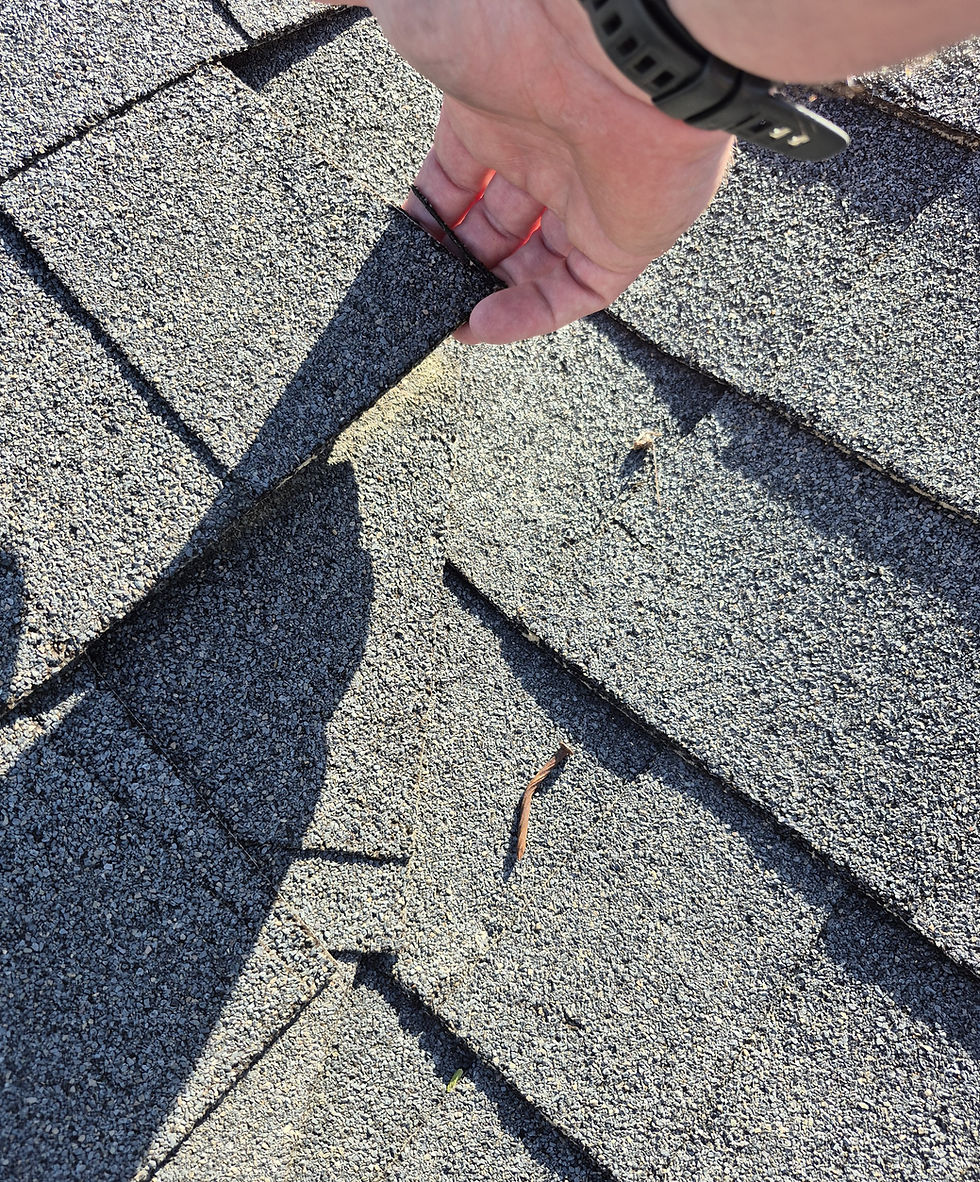
Granule loss. Shingles are coated in protective granules. As they wear off, you will see bald or shiny spots on the shingles, and you will often find the granules collecting in the gutters. Losing granules exposes the shingle to more UV and speeds up the aging.
Fiberglass showing through. On a worn shingle, as the granules and asphalt wear away, the underlying fiberglass mat can become visible, especially at the edges and corners. That is a sign the shingle is late in its life.
Cracked or brittle shingles. Older shingles dry out and crack.
Missing or wind-lifted shingles. A missing shingle is an open door for water to reach the roof deck and needs prompt attention.
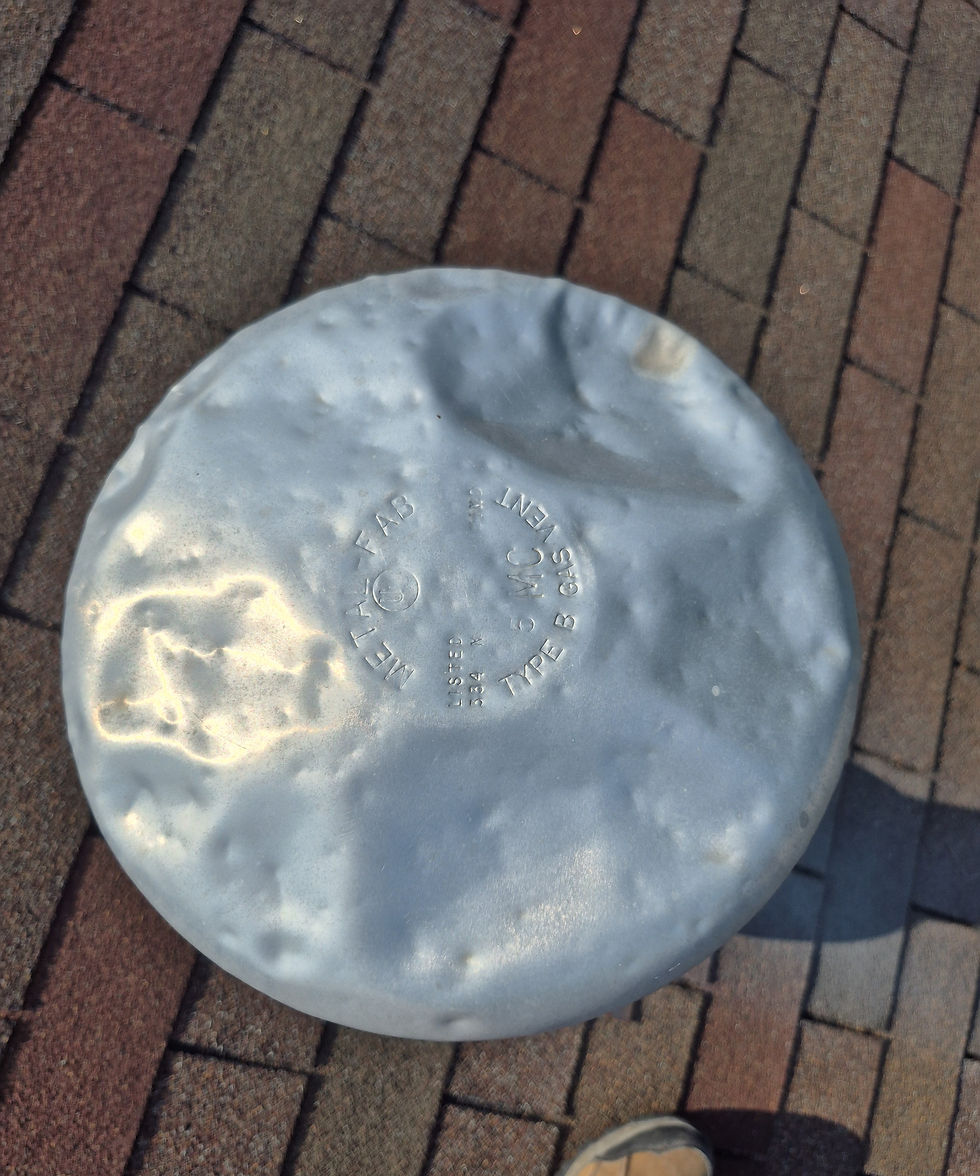
Hail dents. Dents on the shingles, flashing, or vent caps point to hail impact. A good tip: if your gutters or flue caps are dented, there is a good chance the shingles took damage too.
Exposed or popping nails, and organic growth. Popped nails and moss or algae growth are both worth noting on an older roof.
The most common signs of an aging or failing asphalt shingle roof are curling or cupping shingles, widespread granule loss (including granules collecting in the gutters), cracked or brittle shingles, the fiberglass mat showing through at shingle edges, missing or wind-lifted shingles, and dents from hail on the shingles, flashing, or vent caps. Any of these is worth having evaluated by a licensed roofing contractor, especially on an older roof or after a major storm.
How do you figure out where your roof is in its lifecycle?
This is the part that actually helps you budget. You cannot get an exact number of years remaining, but you can place your roof within its expected life, and that is enough to plan around. It comes down to three steps.
1. Find out when the roof was installed. This is the single most useful piece of information, and it is one an inspector cannot determine on their own. We strongly recommend asking the current property owner when the roof covering was installed. If there is a receipt, a permit record, or a roofing company's paperwork, even better.
2. Identify the shingle type. Architectural (also called dimensional) shingles are thicker and layered, with a varied, three-dimensional look. Basic 3-tab shingles are flat and uniform. The two have different expected lifespans.
3. Compare the age to the typical lifespan range. Once you know the age and the type, you can see roughly which third of its life the roof is in.
Here are the ranges we use in our reports, broken into thirds so you can see the lifecycle at a glance.
Architectural composition shingles (typically a 21 to 24 year lifespan):
Lifecycle stage | Approximate age |
First third of life | 1 to 8 years |
Second third of life | 8 to 16 years |
Last third of life | 16 to 24 years |
3-tab asphalt composition shingles (typically a 12 to 18 year lifespan):
Lifecycle stage | Approximate age |
First third of life | 1 to 6 years |
Second third of life | 6 to 12 years |
Last third of life | 12 to 18 years |
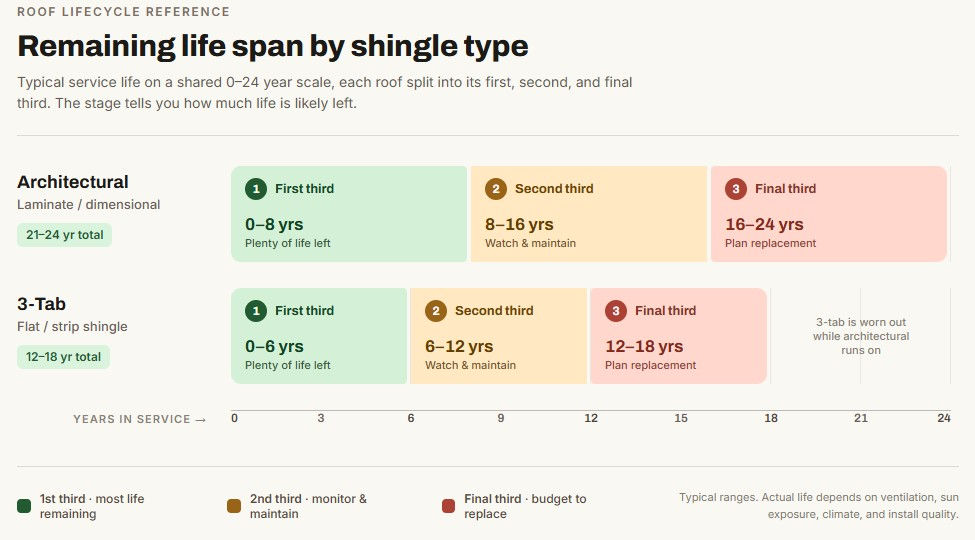
Here is how to use it. Say you learn a roof is architectural shingle installed 10 years ago. That puts it early in its second third of life. You very likely have years left, but it is a smart time to start setting money aside. Now say the roof is a 15-year-old 3-tab. That is in its last third, so replacement is on the horizon and worth planning for sooner rather than later.
One important rule: plan conservatively. The ranges above assume a roof that is aging normally. Extreme weather, a manufacturing defect, or an installation error can move a roof toward the end of its life faster than its age alone would suggest. When you are budgeting, it is safer to assume the shorter end of the range than the longer end.
How we address roof age directly in the report
We do not hide behind vague language on this, and we do not guess. Here is the kind of language you will find in the roof section of a Tech Inspect report:
"Determining the exact operational lifespan remaining on a roof is impossible, but providing context on its current age is important for planning future home expenses. It is strongly recommended to discuss with the current property owner when the current roof covering was installed. If that date can be determined, homeowners can use that information coupled with the provided information regarding typical lifespans to determine the lifecycle stage of the current roof covering. This can be used for replacement planning, which should always be conservative in its estimation. Tech Inspect Home Services strongly recommends having a professional roofing contractor review the entire roof and provide a more detailed analysis of its current condition." "It is important for every homeowner to understand that the lifespan of a roof covering can be shortened due to extreme weather events (for example, hail and high winds), factory defects, and installation errors. Since the inspector was not present at the time of installation, there is no way to determine the actual age of the roof, and any such estimations provided are done so as a courtesy to the client." "Note: Due to the many variables which affect the lifespan of roof covering materials, remaining service life of any roof coverings is not estimated. This is in accordance with all industry inspection Standards of Practice."
And here is how a specific finding reads in a report, in our standard Finding, Implication, Recommendation format:
Observation: The roof covering is architectural (dimensional) composition shingle. Granule loss and edge wear were observed, with the fiberglass mat visible at several shingle edges. Implication: Granule loss and mat exposure indicate the shingles are aging and their protective surface is wearing away, which reduces their remaining service life and their ability to shed water over time. Recommendation: Discuss the installation date with the current owner, and have a licensed roofing contractor evaluate the entire roof to assess its condition and provide repair or replacement options and cost. Plan for eventual replacement conservatively.
Can a home inspector tell me how many years my roof has left?
No, and it is worth understanding why, because it protects you.
An inspector was not present when the roof was installed, so we cannot know its true age on our own. Even if we could, the lifespan of any given roof depends on weather events, installation quality, ventilation, and manufacturing, all things that vary from house to house. Any age estimate we provide is offered as a courtesy to help you plan, not as a guaranteed number. And by professional standard, remaining service life of a roof is not estimated at all. Under the InterNACHI Standards of Practice, the inspector is not required to walk the roof or to predict its service life expectancy. That standard exists across the industry for good reason: an honest "we cannot predict this" is more useful to you than a confident number that turns out to be wrong.
What we do instead is document the current condition thoroughly, with photos and video, so you can see exactly what the roof looks like today. We assess the roof from the ground, from the eaves with a ladder where we can, and with a drone that carries a high-resolution camera, which lets us get a close look at the shingles, flashing, penetrations, and overall condition from multiple angles without walking a surface that may be unsafe. From there, you know where the roof stands, and you have what you need to bring in a roofing contractor for the details.
Why get a roofing contractor to look at the roof?
The inspection tells you the roof's current condition and its likely lifecycle stage. A roofing contractor tells you what it will actually cost to repair or replace, and that is the number your budget really needs.
We strongly recommend having a professional roofing contractor review the entire roof and provide a more detailed condition analysis, especially if the roof is showing wear, is late in its lifecycle, or has taken a recent storm. A contractor can get on the roof, check areas that are not visible from the ground, and give you a written quote with options. Roof replacement costs vary widely based on the size and pitch of the roof, the material, your local labor market, and how much of the underlying structure needs work, so a real quote from a local contractor beats any ballpark figure. If the roof has storm damage, that conversation may also involve your insurance carrier.
This is also where a pre-listing inspection pays off for sellers. If you are selling and the roof is a question mark, finding out where it stands and getting a contractor's quote before you list lets you price the home accurately and get ahead of buyer negotiations instead of reacting to them. You can read more about that in our post on why a pre-listing inspection is a seller's best secret weapon.
How does roof age affect buying a home?
An aging roof is one of the most common things buyers ask us about, and it is worth keeping in perspective. A roof that is late in its life is not automatically a dealbreaker, and it is not automatically a "major concern" either.
Whether an aged roof matters to you depends on your budget, your timeline, and your risk tolerance. For one buyer, a roof with a few years left is fine, and they will replace it when the time comes. For another buyer, or on a different home, that same roof might be a reason to renegotiate or to keep looking. The inspector's job is to document the condition and give you the context. The decision, and any negotiation strategy, belongs to you and your agent.
It also helps to know that a roof being near, at, or beyond the end of its normal useful life is not, by itself, a material defect. Age alone does not make a roof a major structural or safety issue. What matters is the actual condition and what it would take to address it. This comes up often with older homes, where the roof is naturally one of the components most likely to be nearing the end of its service life, so it is worth having a clear picture and a contractor's quote before you decide.
One last connection worth making: the roof does not work alone. It is part of the home's whole water-management system, along with the flashing, gutters, and downspouts that carry water away from the house. If you want to go deeper on that side of things, our post on gutters and where downspouts should discharge is a good next read.
In Summary:
A roof is a wear item, like the tires on your car, and it ages based on everything the weather throws at it. You cannot get an exact number of years remaining, and any inspector following professional standards will tell you the same. What you can do is find out when the roof was installed, identify the shingle type, compare the age to typical lifespan ranges, watch for the physical signs of wear, plan conservatively, and get a roofing contractor's detailed assessment for the real numbers. A thorough inspection documents the current condition so you always know where you stand.
To make planning easier, our free Resources and Downloads page includes the InterNACHI Standard Estimated Life Expectancy Chart, a handy reference for the roof and for the many other components and building materials you will eventually plan to repair or replace.
Don't want to climb the roof?
Not comfortable on a ladder, or have a two-story home? You do not have to get up there yourself. We offer a standalone roof inspection so you can get a professional look at your roof's condition without the risk. You can learn more about that on our additional inspection services page.

See exactly how we document it
The clearest way to understand how we report on a roof is to open a real report. We have published three full sample reports you can click through just like a client would, with the photos, video, and plain-English findings in place. It takes about two minutes, and it is the best picture of what you will walk away with.
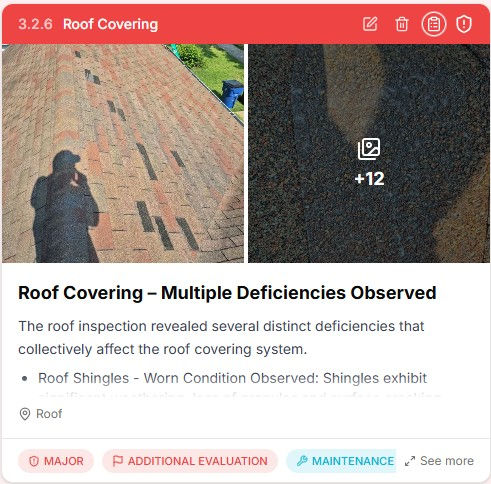
When you are ready, see everything inside a Tech Inspect report or schedule your inspection, with same-week availability, weekend appointments, and a report delivered within 24 hours.
Frequently asked questions
How long does a roof last? Most asphalt shingle roofs in the Midwest last between 12 and 24 years, depending on the shingle type and the conditions the roof is exposed to. Architectural shingles typically carry a 21 to 24 year lifespan, and 3-tab shingles typically carry a 12 to 18 year lifespan. Weather, installation, ventilation, and manufacturing all affect the real-world result.
How long do architectural shingles last? Architectural, or dimensional, composition shingles typically carry a 21 to 24 year lifespan. Roughly, the first third of that life is age 1 to 8 years, the second third is 8 to 16 years, and the last third is 16 to 24 years. Heavy hail, high wind, poor ventilation, or installation errors can shorten it.
How long do 3-tab shingles last? 3-tab asphalt composition shingles typically carry a 12 to 18 year lifespan. Roughly, the first third is age 1 to 6 years, the second third is 6 to 12 years, and the last third is 12 to 18 years.
What are the signs I need a new roof? Common signs are curling or cupping shingles, widespread granule loss, granules collecting in the gutters, cracked or brittle shingles, the fiberglass mat showing through at the edges, missing shingles, and hail dents on the shingles, flashing, or vent caps. Any of these is worth having a roofing contractor evaluate.
Can a home inspector tell me how old my roof is? Not exactly. An inspector was not present when the roof was installed, so the actual age cannot be determined during an inspection. We strongly recommend asking the current property owner when the roof was installed, then comparing that date to typical lifespan ranges to estimate the roof's lifecycle stage.
Can a home inspector tell me how many years my roof has left? No. Remaining service life is not estimated, in accordance with industry Standards of Practice, because too many variables affect a roof's lifespan. An inspector documents the roof's current condition and can provide age context as a courtesy, but for a detailed condition analysis and cost, a licensed roofing contractor should review the roof.
Does an old roof mean I should not buy the house? Not necessarily. A roof near the end of its serviceable life is not, by itself, a major defect. Whether it matters depends on your budget, timeline, and risk tolerance, and on what a contractor's quote says. The inspection gives you the condition and the context so you and your agent can decide.
How big does hail have to be to damage a roof? Asphalt shingles generally begin sustaining functional damage from hail about 1 inch in diameter, roughly the size of a quarter. A good indicator is your gutters and vent caps: if they are dented, there is a good chance the shingles took damage too.
Does attic ventilation affect how long a roof lasts? Yes. A poorly ventilated attic traps heat and moisture against the underside of the roof, which can bake the shingles from below and shorten their life. Good soffit-and-ridge ventilation helps a roof reach its expected lifespan.
Ready to know where your roof stands?
Same-week availability, weekend appointments, and a report delivered within 24 hours. See three full sample reports, explore everything inside the report, or schedule your inspection.
Tech Inspect Home Services LLC · 3580 Highway T, Marthasville, MO 63357 · 636-201-6366 · sean@techinspecthome.com


