Gutters Draining Onto the Roof: Why It Wears Out Your Shingles (and When It's Okay)

If you've ever looked up at a two-story house and noticed a downspout that stops on top of the lower roof, you've spotted one of the more common home inspection issues we see across the St. Louis area The upper gutter catches the water just like it should, then the downspout dumps all of it onto the shingles below, in the same spot, every time it rains.
Over time, though (especially when we get the big missouri rains), that stream scrubs the protective granules off the shingles in its path, and that patch of roof starts to wear out faster than the surrounding roof.That being said, not every gutter draining onto a roof is a problem. The roof material, how much water is coming down, and where it lands all make a difference.
An upper gutter should drain into the lower gutter, or all the way to the ground, instead of onto the roof below. A downspout that empties onto a lower roof sends the runoff from the entire upper roof onto one small patch of shingles. Over time that flow can erode the shingles' mineral granules, which protect the asphalt from UV rays and weather, so the shingles in that path wear out earlier than the surrounding shingles. Shingle manufacturers including GAF and Malarkey recommend against it, and GAF's limited warranty doesn't cover granule loss or erosion caused by upper downspouts draining onto lower roofs. On a standing seam metal roof there are no granules to wash off, so the wear concern is lower.
Why shouldn't a gutter drain onto a lower roof?
An upper gutter gathers the runoff from that whole upper roof section and funnels it into one downspout. If that downspout ends on the lower roof, the lower roof takes all of that water in one concentrated stream, on the same few shingles, every rain.
The shingle manufacturers advise against this installation. GAF's technical bulletin TAB-R-150 says damage can occur where downspouts drain from higher roofs directly onto lower ones. Malarkey's technical bulletin recommends against it too, and cites the Asphalt Roofing Manufacturers Association (ARMA), whose roofing manual says to connect an upper downspout to the lower gutter instead.

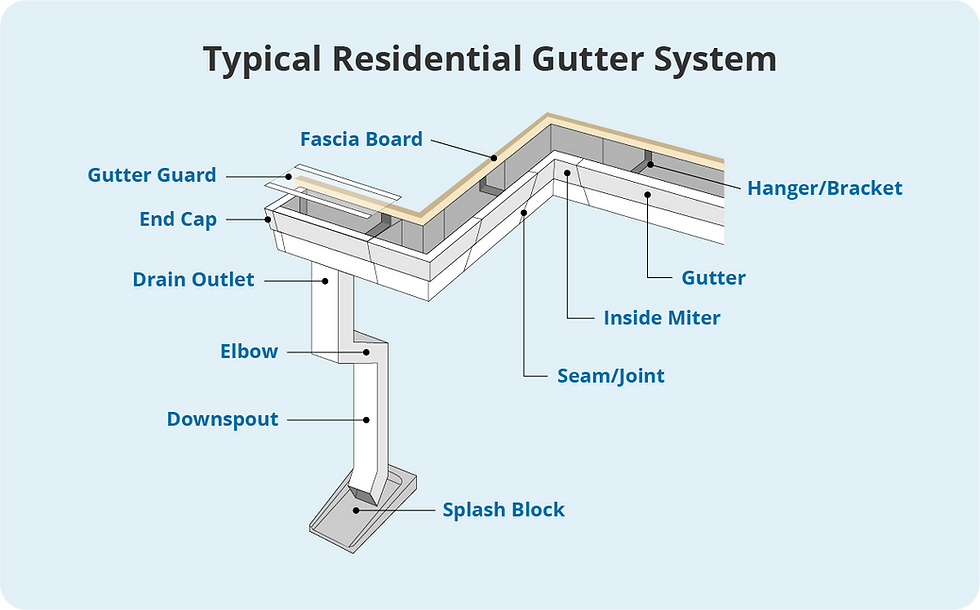
The diagram shows two versions of the same problem: a downspout that stops short on the lower roof, and an upper gutter with no end cap that spills out the end.
How does a downspout wear out shingles?
Asphalt shingles are covered in mineral granules, they give the shingle its color and protect the asphalt underneath from UV rays and weather. According to GAF, water pouring out of a downspout can erode the granules on the shingles below it. Once the asphalt is exposed, it weathers faster and those shingles don't last as long.
Water can be a destructive force,if not correctly controlled. Water's on constant is it will take the path of least resistance. How fast a shingle wears out depends on how much water is coming down and how hard/fast it flows. GAF says the erosion may show up within a year or two, sometimes sooner, or barely show over the life of the roof. The context of the installation matters greatly.
GAF and Malarkey also point to a few other problems:
Leaks. A heavy stream can force water between the shingles, and GAF notes it can take years for that leak to show up inside.
Algae and moss. That spot stays wet longer than the rest of the roof.
Sidewall damage. Extra water and splash near a wall can lead to wood rot and flashing corrosion.
How much water does a downspout dump on the roof?
More than most people expect. The U.S. Geological Survey figures 1 inch of rain at 27,154 gallons per acre, which works out to about 0.62 gallons per square foot of roof.
Say the upper roof feeding that downspout is 400 square feet. A 1-inch rain sends roughly 250 gallons onto the same patch of shingles. One of those 3-inch Missouri gully washers? Closer to 750 gallons. Water is the thing we have to manage on a house, and that's a lot of it aimed at one spot.
A real example on a four-year-old roof
We documented this on a roof that was only about four years old. The upper downspout ended right on the lower roof, so everything off that upper section was landing in one spot and starting to wear out the shingles on the way to the gutter. Four years is still early in a roof's life, but that patch of shingles is wearing out sooner than the surrounding area, so this area will require repair and attention to prevent a leak.

Is it ever okay for a gutter to drain onto a roof?
Sometimes. Context is everything, and a few things change the picture:
How much roof feeds it. A small dormer gutter moves a lot less water than one draining half a second story.
What it lands on. Shingles wear out mainly from granule loss. Smooth metal panels don't have granules to lose.
Where it lands. Water dropping next to a sidewall is more likely to cause trouble at that wall.
Whether the lower gutter can keep up. If the water's headed there anyway, that gutter has to handle it.
Here's one we were comfortable with. This upper gutter drains onto a standing seam metal roof, and the water lands in the flat of the panel between the raised seams. There aren't any granules to wash off, and the seams keep the water in its lane all the way to the gutter.

It's still important to follow the water's path and make sure it's not hitting a seam, splashing a wall, or overflowing the gutter below. If you're unsure about your own setup, your roof manufacturer is the best source.
Won't a downspout on the roof look bad?
A downspout running down a roof isn't the prettiest thing on a house, so I understand why why may not want to run it down the roof line. But would you rather look at a downspout, or slowly wear out a patch of shingles over time?
Malarkey points out that grime washed down from the upper roof can leave the lower roof darker and marked with drainage channels, and the extra moisture can lead to algae streaks.
To help it blend in, match the downspout color to the shingles and have a gutter contractor keep the run short and clean. Malarkey's bulletin also shows open and enclosed troughs that carry the water down to the lower gutter.
How do you fix a gutter draining onto the roof?
GAF's options are to extend the downspout into the lower gutter, route it all the way to the ground with a longer downspout, or change the design if the house is still on paper. Malarkey calls a splash block the minimum and a trough or downspout to the gutter the best fix.
If the water's going into the lower gutter, make sure that gutter is sized for it. In a case from our gutters post, runoff from several roof sections ended up in one short lower gutter. It couldn't keep up, water splashed back under the shingles, and the roof decking rotted within a few years of a new roof. That house had other installation problems too, but the overloaded gutter was a big contributing factor.
What does a home inspector look for with upper gutters?
During a home inspection, we follow the water, including where the gutters on upper roofs end up. Depending on the roof, we look from the ladder, with our drone, or on foot when it's safe. If an upper downspout empties onto a lower roof, we photograph it, note any wear we can see, and recommend a fix.
REPORT CALLOUT (sample in your Observation/ Implication / Recommendation format.
Observation: The upper roof downspout discharges directly onto the lower roof surface.
Implication: Concentrated runoff from the upper roof can erode the protective granules on the shingles in the discharge path and shorten their life. It can also increase the chance of leaks at nearby flashing and sidewalls.
Recommendation: Recommend a qualified gutter contractor extend the downspout into the lower gutter or route it to the ground.
Buying? Look up when you tour homes. A downspout ending on a lower roof is usually visible from the yard.
Selling? This is a simple one to handle before you list. A pre-listing inspection can flag it along with everything else.
Frequently asked questions
Should an upper gutter drain onto a lower roof? Generally, no. On an asphalt shingle roof, the upper downspout should empty into the lower gutter or run to the ground. GAF and Malarkey both recommend against draining one roof directly onto another because concentrated runoff can erode shingle granules and lead to leaks.
Does a downspout draining onto my roof void my shingle warranty? According to GAF, its limited warranty against manufacturing defects stays in effect, but granule loss or erosion caused by upper downspouts draining onto lower roofs isn't covered. Warranty terms vary by manufacturer, so check yours.
How fast can a downspout wear out shingles? It depends on how much water comes down and how hard it hits. GAF says granule erosion may be visible within a year or two or less, or barely visible over the life of the roof.
Is it okay for a gutter to drain onto a metal roof? On a standing seam metal roof, there are no granules to wash off, so shingle-style wear isn't the concern. Where the water lands, nearby walls, and the lower gutter's capacity still matter. If you're unsure, check with your roof manufacturer.
Is a splash block on the roof good enough? Malarkey recommends a splash block at minimum, but its preferred fix is a trough or downspout that carries the water down to the lower gutter.
Won't a downspout extension look bad? It can be color-matched and kept to a short run. Malarkey also notes that draining an upper roof onto a lower one can leave the lower roof darker and marked with drainage channels.
Does Tech Inspect check where upper gutters drain? Yes. We check where every gutter and downspout discharges, including upper roofs, and document any downspout emptying onto a lower roof with photos and a recommendation.
Ready for an inspection that follows the water?
Same-week availability, weekend appointments, and a report delivered within 24 hours. See three full sample reports, explore everything inside the report, or schedule your inspection.
Tech Inspect Home Services LLC · 3580 Highway T, Marthasville, MO 63357 · 636-201-6366 · sean@techinspecthome.com