Home Inspection vs. Municipal Occupancy Inspection: What's the Difference in Missouri?

Buying or selling a home in St. Louis County? You'll likely hear about two inspections with similar names. The home inspection is the one you hire. The municipal occupancy inspection is the one the city or county may require before anyone new moves in. Mixing them up can cost you time you don't have.
The rules also change at the city limits. St. Louis County has 88 municipalities plus unincorporated areas, and each sets its own occupancy requirements.
A home inspection and a municipal occupancy inspection are two separate inspections. A home inspection is a private, visual inspection you hire to learn a home's condition before you buy it. It has no pass or fail, and it isn't a code inspection. An occupancy inspection is a government inspection required by local ordinance. It checks the home against the local property maintenance code, and any cited violations have to be corrected before an occupancy permit is issued. In St. Louis County, unincorporated areas require one for sales and rentals, and each municipality sets its own rules.

What is a municipal occupancy inspection?
An occupancy inspection (also called a re-occupancy or occupancy permit inspection) is a government inspection required by local ordinance before a new owner or tenant moves in. An inspector checks the home against the local property maintenance code, cited violations get corrected, and then the city issues an occupancy permit.
St. Louis County's program is built on the International Property Maintenance Code. Many municipalities contract with the county for these inspections, while others, like Ballwin and Overland, run their own.
Missouri law draws a line here. Since August 28, 2024, a state statute (RSMo 436.345) has barred cities and counties from requiring a home inspection before a home sale. It specifically exempts occupancy permit inspections, so cities can still require those.
Does St. Louis County require an occupancy inspection when you sell a house?
It depends on where the house sits. Unincorporated St. Louis County requires an occupancy inspection when a home is sold or rented. Inside a municipality, the city's rules apply. A few examples, from each government's published information as of November 2026:
Location | What's required |
Unincorporated St. Louis County | Occupancy inspection for sales and rentals |
Ballwin | Inspection before a change in occupancy, whether the home is sold or rented |
Wildwood | Rentals and non-owner-occupied homes only (effective March 1, 2025) |
Crestwood | Rentals only; owner-occupied sales are exempt |
Chesterfield | No re-occupancy permit needed to sell an existing home |
Programs change, so confirm with the city, or with St. Louis County for unincorporated areas, before you list or write an offer. A mailing address doesn't always match the city limits, so ask your agent which jurisdiction the home is actually in. Some fire protection districts, including Metro West, require their own inspection too.
How is an occupancy inspection different from a home inspection?
Home inspection | Occupancy inspection | |
Required by | Nobody; it's your choice | Local ordinance, where one exists |
Usually ordered by | The buyer | The seller or owner |
Performed by | A private inspector you hire | A city or county inspector |
Measured against | InterNACHI Standards of Practice | The local property maintenance code |
Result | A detailed report, no pass or fail | Pass, or a list of violations to fix |
Purpose | Help you decide on the home | Confirm minimum standards are met |
A home inspection isn't a code inspection. InterNACHI's Standards of Practice, which we follow, say inspectors aren't required to determine code compliance. Our job is to document the home's condition today with photos and video and explain why each finding matters. See what a home inspection covers, and why "up to code" isn't the same as "built well".
What does a St. Louis County occupancy inspector look for?
St. Louis County publishes a guide to what its occupancy inspectors look for. A few examples:
Smoke detectors on every level, in each bedroom, and in halls within 15 feet of a bedroom
GFCI protection for kitchen countertop, bathroom, and outdoor outlets
Handrails on stairs with more than four risers
A fire-rated door between an attached garage and the living space
House numbers at least 4 inches tall, visible from the street
Grass no taller than 8 inches
Some of those overlap with what we'd flag in a home inspection. Others, like grass height, are about neighborhood standards. Bel-Nor, another St. Louis County city, sums it up on its FAQ page: its occupancy inspection is a property maintenance inspection, not a performance inspection.
The county guide lists GFCI protection as a requirement. A home inspection report explains it:
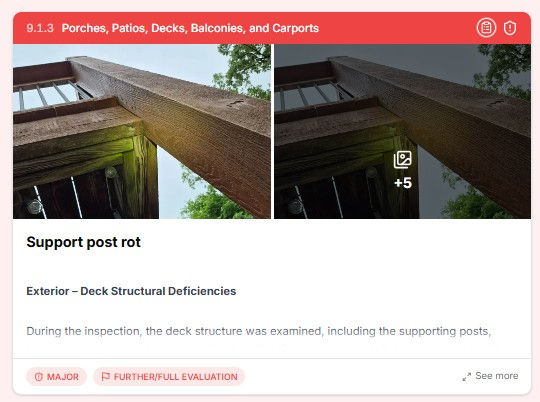
Example: how a home inspection report portrays it. Observation: The receptacles serving the kitchen countertop are not GFCI protected. Implication: A GFCI shuts off power when it senses a ground fault, which helps protect people from serious shock in areas near water. Without it, that protection is missing. Recommendation: Have a licensed electrician install GFCI protection for the countertop receptacles.
If the house passed its occupancy inspection, do you still need a home inspection?
We recommend one, and so do some of the governments that run these programs. The City of St. Louis says its occupancy inspection doesn't guarantee the overall condition of the building or its systems, and it suggests buyers consider a separate building inspection. Ballwin's housing code handbook recommends a private inspection for anything outside the city's scope.
A passed occupancy inspection means the home met minimum standards on inspection day. It isn't built to give you a detailed, photo-documented look at the home's condition to help you decide whether to buy, ask for repairs, or walk away.
It works both ways, too. A home inspection can't replace a required occupancy inspection.

Who handles the occupancy inspection, the buyer or the seller?
In the programs we reviewed, the owner or the owner's agent usually applies for the inspection, and the permit goes to the new occupant. St. Ann's city code works this way, for example.
Who pays for cited repairs is settled in your purchase contract, so talk it through with your agent. Selling as-is? The occupancy requirement comes from local ordinance, so ask the city how it handles as-is sales before you sign.
How does the occupancy inspection affect your closing timeline?
It can become the slowest part of the deal. In February 2024, St. Louis REALTORS reported county occupancy inspection waits of up to four to six weeks heading into spring and advised agents to apply when the listing agreement is signed. After the inspection, St. Louis County gives the owner 90 days to correct cited items, and some fixes, like structural repairs or new wiring, need a permit.
Your home inspection runs on a much shorter clock. Most of our buyers have a 10 to 15 day inspection window, so book it as soon as your offer is accepted.
Home inspection tips for sellers: order the occupancy inspection when you sign the listing agreement. A pre-listing home inspection gives you time to get quotes and make repairs. It follows the InterNACHI Standards of Practice rather than your city's code, so it can't predict exactly what the city will cite.
Home inspection tips for buyers: ask your agent early whether the occupancy inspection has been ordered and what it cited. If the seller agrees to repairs, here's how to verify them before closing.
What about the City of St. Louis and other counties?
The City of St. Louis is separate from St. Louis County and runs its own program. For residential sales, it requires a Certificate of Inspection before the new owner moves in. Elsewhere in our service area, it's city by city, too. St. Peters, for example, requires an occupancy permit for non-owner-occupied homes and rentals.
Buying a rental? Where rental occupancy programs exist, expect the inspection to come back around when tenants change. Our investment property inspection guide covers more, and Property Condition Documentation gives landlords a dated record of a unit's move-in and move-out condition, which the city's inspection doesn't do.
To Summarize the Differences:
An occupancy inspection checks a home against the city's minimum standards before someone new moves in. A home inspection gives you a detailed look at the home's condition so you can decide what to do about it. In St. Louis County, you may need both, so confirm the rules early.
Frequently asked questions
What's the difference between a home inspection and an occupancy inspection in Missouri? A home inspection is a private, visual inspection you hire to learn about a home's condition. It has no pass or fail and isn't a code inspection. An occupancy inspection is a government inspection required by some Missouri cities and counties. It checks the home against the local property maintenance code, and cited violations have to be corrected before an occupancy permit is issued.
Does St. Louis County require an occupancy inspection to sell a house? In unincorporated St. Louis County, yes, for both sales and rentals. Inside the county's municipalities, it depends on the city. Ballwin requires one when a home is sold or rented, Wildwood and Crestwood only require one for rentals or non-owner-occupied homes, and Chesterfield doesn't require one to sell an existing home. Always confirm with the city.
Can a Missouri city require a home inspection before a sale? No. Under RSMo 436.345, effective August 28, 2024, a city or county can't require a property owner to get a home inspection before selling a residential property. The law doesn't apply to occupancy permit or new construction inspections, so those can still be required.
If a house passed its occupancy inspection, do I still need a home inspection? We recommend one. An occupancy inspection checks a home against minimum property maintenance standards. The City of St. Louis notes that its inspection doesn't guarantee the overall condition of a building or its systems and suggests buyers consider a separate inspection.
Who orders the occupancy inspection, the buyer or the seller? It varies by city. In many St. Louis County programs, the owner or the owner's agent applies for the inspection, and the occupancy permit is issued to the new occupant. Who pays for any required repairs is negotiated in the purchase contract.
How long does it take to get an occupancy inspection in St. Louis County? It varies with demand. St. Louis REALTORS reported waits of up to four to six weeks heading into the spring 2024 selling season and encouraged agents to apply for the inspection when a home is listed.
Does Tech Inspect perform municipal occupancy inspections? No. Occupancy inspections are performed by city or county inspectors, or by inspectors the city authorizes. Tech Inspect performs private home inspections for buyers and pre-listing inspections for sellers across West St. Louis County and St. Charles, Franklin, Warren, and Lincoln counties.
Ready to get the full picture on your next home?
Same-week availability, weekend appointments, and a report delivered within 24 hours across West St. Louis County and St. Charles, Franklin, Warren, and Lincoln counties. See three full sample reports, including a 100-year-old home in St. Louis County, explore everything inside the report, or schedule your inspection. Selling? Start with a pre-listing inspection.
Tech Inspect Home Services LLC · 3580 Highway T, Marthasville, MO 63357 · 636-201-6366 · sean@techinspecthome.com