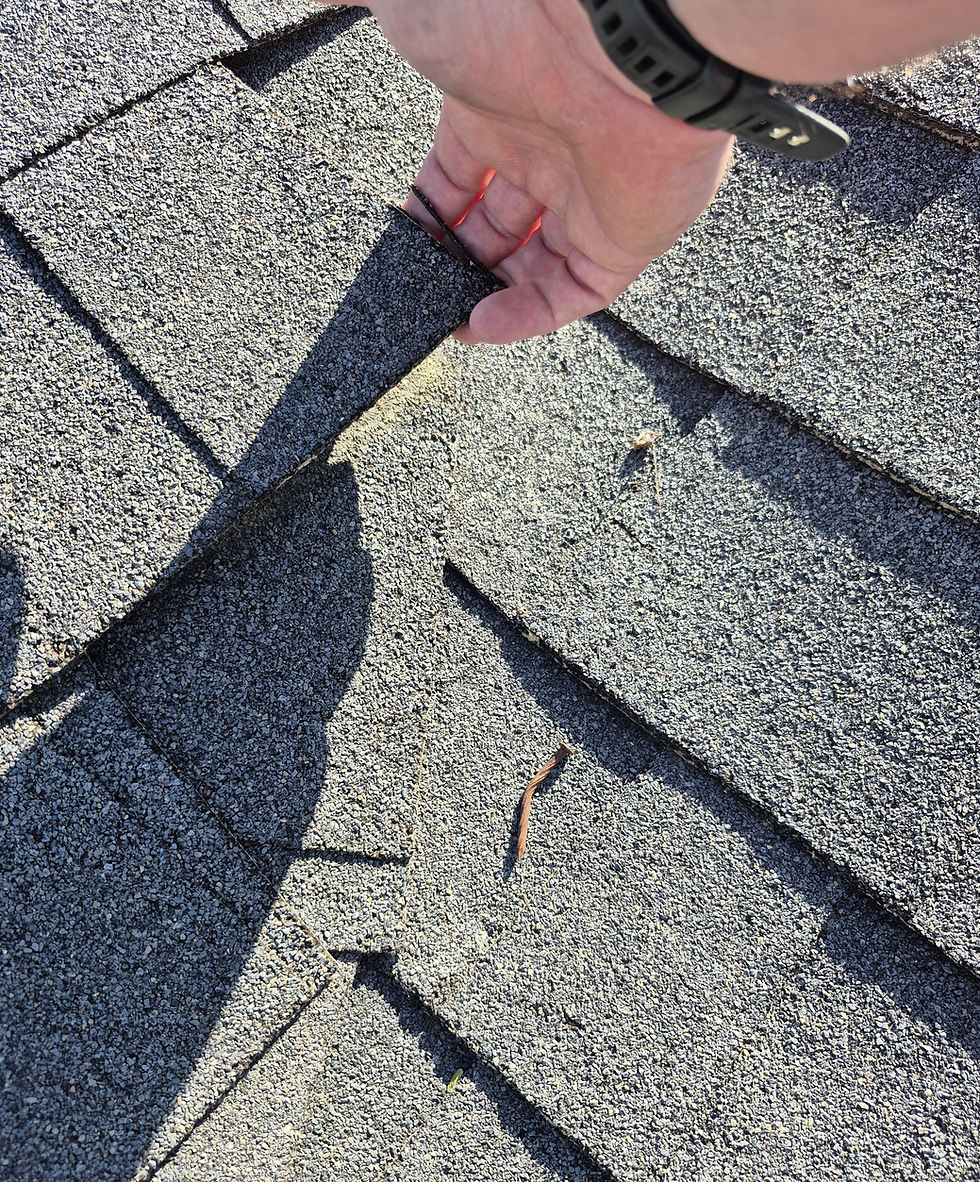
Loose or Peeling Shingles: What Causes Them, Why Wind Makes Them a Problem, and How to Reseal Them

A loose shingle doesn't look like much from the driveway. It's usually one tab with the bottom edge sticking up, or a corner starting to peel back. It's also one of the more common home inspection issues we document on asphalt shingle roofs across St. Charles, St. Louis, Franklin, Warren, and Lincoln counties.
The good news is that a shingle that's loose but still in one piece is usually an easy fix, and often one a homeowner can handle with a caulking gun and a tube of roof cement.
Loose or peeling shingles are shingles whose factory sealant strip has let go of the shingle below. Common causes include age, cold-weather installation, shade, debris on the sealant strip, and nailing problems. An unsealed shingle can flap in the wind until it creases, tears, or blows off, exposing the underlayment to water. A loose shingle that isn't creased or torn can usually be hand-sealed with quarter-size dabs of asphalt roof cement (ASTM D4586), the product most people call roofing tar.

What holds a shingle down in the first place?
Asphalt shingles are held on two ways: nails and a sealant strip. The sealant strip is a line of asphalt-based adhesive applied at the factory, either on top of the shingle or on the back near the bottom edge. Once the roof is on, the sun warms the strip and it bonds each shingle to the one below it.
The nails keep the shingle on the roof. The seal keeps the bottom edge down so the wind can't get under it.


What causes shingles to come loose?
Age and weather. UV breaks down asphalt, and a roof's temperature can swing 80 to 90 degrees in a single day. Over the years, the sealant loses its grip and tab edges start to peel up and curl.
Not enough heat to seal. Sealant strips need several days of warm sun. Shingles installed in fall or winter may not seal until spring, and shingles in heavy shade may never fully seal.
Debris on the strip. Dirt or leaves caught between shingles before they seal can keep them from bonding.
Nailing problems. Nails placed or driven wrong can cause sealing failures and raised tabs. Nails can also back out over time and push up the shingle above.
Foot traffic. Cold, stiff shingles can crack or lose their seal just from being walked on.
Wind exposure. Uplift is strongest at the corners, eaves, rakes, and ridges, so loose shingles often show up there first.
Why do older roofs have more loose shingles?
A shingle's seal is strongest right after it bonds, and it's downhill from there. The Insurance Institute for Business & Home Safety (IBHS), which tracks how real roofs age on its outdoor test farms, reports that wind resistance starts declining as soon as shingles seal. After about 7 to 10 years, the sealant has weakened enough to significantly reduce its hold, and some tabs let go completely.
That lines up with what we see in the field. A newer roof might have a loose tab or two near a ridge. An older roof will often have loose tabs across several slopes.
The occasional loose shingle is generally treated as a maintenance item. Widespread unsealing and curling is a sign of age, and resealing a few tabs won't reverse it. If that's your roof, talk to a roofer about the bigger picture.
Why is it a problem when the wind gets under a shingle?
Wind blowing across a roof creates suction that tries to pull the shingles up. A loose tab gives the wind an edge to grab, and every time it flaps, it bends at the same spot. That leaves a crease, then a tear, and then the tab is gone. Forensic engineers point out this can happen in everyday wind that's nowhere near storm strength.
One missing shingle is rarely the end of it. IBHS notes that once one tab fails, it can set off a cascade that rips off the shingles around it. That exposes the underlayment, which isn't designed to stand up to wind, and the roof can no longer shed water like it should.
From there, water gets into the decking. Most of the roofs we see are sheathed with OSB, and OSB doesn't handle water well. It swells and can start to delaminate, sometimes long before a stain shows up on a ceiling.
Can you reseal loose shingles yourself?
Often, yes. Manufacturers call it hand-sealing, and it's the same method roofers use for repairs. The product most people call roofing tar is asphalt roof cement. Look for one labeled ASTM D4586, or a sealant your shingle manufacturer approves.
Pick a dry, mild day. Cold shingles can crack when they're bent or walked on.
Lift the loose tab gently and brush out any dirt or granules. If it's brittle and won't flex, don't force it.
Apply quarter-size dabs of cement to the shingle below, under the loose edge. Follow your shingle brand's instructions if you know them. As a guide, one manufacturer calls for four dabs under a laminated (architectural) shingle, and three-tab shingles get at least one under each tab.
Press the shingle firmly into the cement.
More isn't better. GAF warns that too much cement can run down the shingle or cause blistering.
Call a roofer instead if:
The shingle is creased, torn, or missing. A crease means it's already damaged, and gluing it down won't fix that. It should be replaced.
The roof is steep, two stories, or wet. For perspective, we don't walk roofs steeper than a 6:12 pitch during inspections.
A storm may have caused it. Take dated photos and talk to your insurance agent before making repairs.
Loose tabs are everywhere. That's an age question, and a roofer can tell you whether spot sealing still makes sense.
How do loose shingles show up in a home inspection report?
The InterNACHI Standards of Practice only require a roof to be inspected from the ground or the eaves. When it's safe, we go further with a ladder, our drone, and walking the roof, and we photograph what's visible: lifted, peeling, curled, creased, or missing tabs.
REPORT LANGUAGE (draft: replace with your exact Spectora narrative before publishing): Finding: Loose, unsealed shingle tabs were observed on the roof. Implication: Unsealed shingles are more vulnerable to wind, which can crease, tear, or remove them and expose the underlayment to water. Recommendation: Hand-seal loose tabs with asphalt roof cement per the manufacturer's instructions and replace any creased, torn, or missing shingles. A qualified roofing contractor is recommended for steep or high roofs.
If you're buying, a few loose shingles are usually a small fix, and how you handle them is up to you and your agent. If you're getting ready for a home inspection before selling, resealing loose tabs is an easy item to knock off the list early. Our post on why a pre-listing home inspection is a seller's best secret weapon explains how to find items like this before a buyer's inspector does.
Frequently asked questions
Why are my roof shingles lifting or peeling? Most loose shingles come down to a sealant strip that has lost its grip. Common causes are age and weathering, shingles installed in cold weather or heavy shade that never fully sealed, debris trapped under the tab, nailing problems, and foot traffic on the roof.
Will loose shingles reseal on their own? Sometimes. New shingles that haven't sealed yet often bond once they get several days of warm sun. An older seal that's been broken may only partly reseal or not reseal at all, so hand-sealing is the safer bet.
What should I use to reseal loose shingles? Use asphalt roof cement that meets ASTM D4586, which is what most people mean by roofing tar, or a sealant approved by your shingle manufacturer. Put quarter-size dabs under the loose edge and press the shingle into them. Too much cement can run down the shingle or cause blistering.
Can I glue down a creased shingle? It's better to replace it. A crease means the shingle has already been damaged, and gluing it flat won't fix that. Once it's replaced, the shingles around it should be hand-sealed.
Is a loose shingle considered wind damage for insurance? It depends on your policy and what caused it. Roof damage engineers commonly don't treat a loose shingle as wind damage unless it's creased, torn, or missing. If you think a storm caused it, take dated photos and call your insurance agent before making repairs.
What does a home inspector look for on a shingle roof? Under the InterNACHI Standards of Practice, the inspector looks at the roof covering, gutters, downspouts, vents, flashing, skylights, chimneys, and other roof penetrations. On a shingle roof, that includes visible loose, lifted, curled, creased, or missing shingles. Tech Inspect documents these with photos in the report.
How long do shingles stay sealed? There's no set number. IBHS research shows a shingle roof's wind resistance starts dropping as soon as the shingles seal, and after about 7 to 10 years the sealant has weakened enough to significantly reduce it. Some tabs come completely unsealed.
Want a second set of eyes on the roof?
Same-week availability, weekend appointments, and a report delivered within 24 hours. See three full sample reports, explore everything inside the report, or schedule your inspection.
Tech Inspect Home Services LLC · 3580 Highway T, Marthasville, MO 63357 · 636-201-6366 · sean@techinspecthome.com